R STAR
Lessons in Music and Humanity
UCR conductor Ruth Charloff focuses on the human element of making music
By Susan Mashiyama
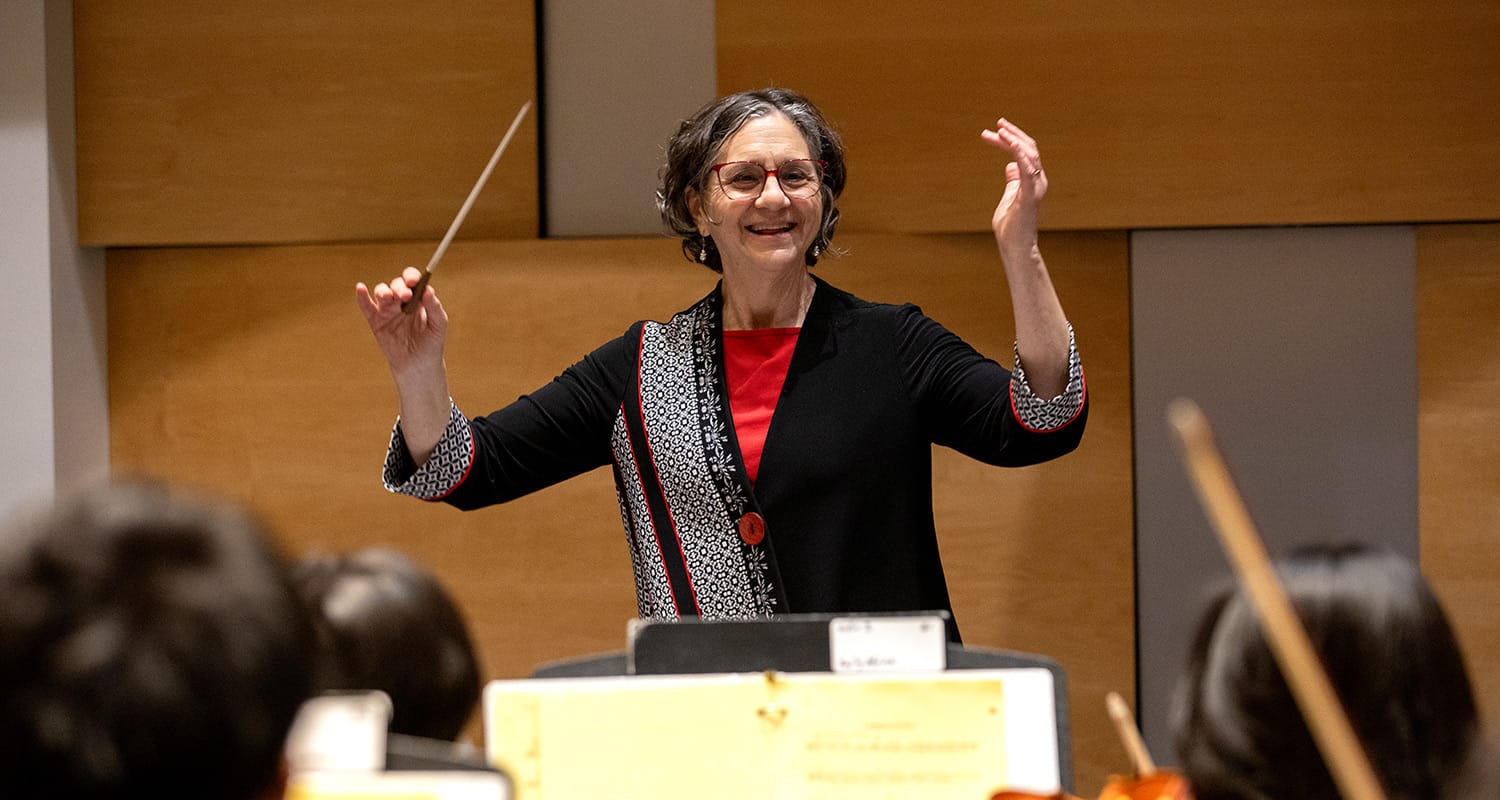
F or over 30 years, UCR choral and orchestral director Ruth Charloff has made it her mission to cultivate and share the deep educational and social value of performing music together — something she emphasizes is especially important today.
“What musical ensembles offer is so radically different from what students may be doing in other classes,” said Charloff, a lecturer in the Department of Music who also serves as director of the UCR Chamber Singers, UCR Chorale, and UCR Orchestra. “There’s no possibility for shortcutting the learning process — no AI, no outsourcing possible in preparing for a performance. It’s just us and what we can bring: our skills, ears, and understanding.”
Preparation for each of the ensembles’ performances takes many weeks, she said, calling the process a community achievement that is only possible with all individual members learning together.
“When we start on a new piece or a new skill, there’s a kind of resilience we develop in living through the discomfort of being really bad at it at first,” she said. “It’s an authentic and demanding process, and the reward is not a grade, but meaning and beauty.”
That human element feels increasingly urgent to Charloff. Over the summer, she read a report released by MIT about signs that AI is increasing isolation and undermining student mastery and confidence. The findings reinforced for her the value of teaching subjects, like musical performance, that are intrinsically human.
Charloff said she is struck by the extent to which such activities fill deep mental health needs. She routinely sees UCR students making new friends within the ensembles while being inclusive, supportive, and kind to one another. It’s not rare for students to tell her, “This got me through the year.”
“What we do requires students to put their own humanity, as well as the humanity of the music, front and center,” she said.
Charloff got her start in music early on, playing piano as a child and flute in her high school orchestra. She was introduced to choral music in college, an experience she describes as “life changing.”
As part of the college choir, she had the opportunity to sing works she considers masterpieces. Performing them required understanding and expressing the meaning of both lyrics and music, becoming proficient in vocal techniques, and collaborating with others.
“Ensemble singing addresses the whole person: physically, emotionally, vocally, and aurally,” she said.
Charloff also became interested in conducting during this time. She recounted a rehearsal early in her college days when an inexperienced student conductor took the helm and the forward motion of the music suddenly became labored and difficult. For the first time, she realized what a skillful conductor gives to a group — and how much an unskilled conductor can get in the way.
“I just had an intuition that I could do it,” she said.
While a graduate student in musicology and ethnomusicology at UC Berkeley, Charloff became a teaching assistant for renowned musicologist and conductor Philip Brett, who was impressed by her skills in conducting. After Brett left Berkeley for UCR, where he chaired the music department from 1991 to 2001, Charloff followed her instincts and transferred to Northwestern University to focus on studying conducting, earning a doctorate in musical arts.
After graduating, Brett encouraged Charloff to apply for a conducting lectureship at UCR. He said he thought the campus’s small music department needed “a person who viewed music making within a humanities framework, connecting to fields including literature, history, and religion.” She was hired by the music department in 1995, where she has remained since.
Charloff first became director of the UCR Chamber Singers and took on the role of conductor for the UCR Orchestra two years later when former conductor Tony Ginter retired. Over the last three decades, she has also taught classes in music history, music theory, conducting, and instrumentation.
When the COVID-19 pandemic hit and UCR Chorale Society conductor Edward Bruner retired, Charloff took on the additional role. She has since seen the group, renamed the UCR Chorale, triple in size and now focuses exclusively on directing the three ensembles.
The separation caused by the pandemic brought into sharp focus for Charloff how much of learning music occurs through being together. She recalled how even basic skills such as producing accurate pitch were hard for the first group of returning students. But it has been reassuring to her to see that subsequent groups have recovered well.
Participation in the Chorale, Chamber Singers, and Orchestra extends beyond students, with faculty, staff, and community members also forming the ensembles. This unique arrangement has helped strengthen ties between the campus and community as well as provide students with role models. The Chorale is especially inclusive, with no auditions or music-reading ability required to join.
This spirit of community and collaboration was on full display last spring when both choirs and the orchestra came together to perform Vaughan Williams’ “Dona Nobis Pacem,” a 1936 cantata that explores themes of war and peace and incorporates poetry by Walt Whitman and sections from the Bible. Charloff described it as an achievement that was meaningful for both the audience and the performers.
Charloff aims for balance between staples of the choral and orchestral repertoire and the vast array of music available beyond what is traditionally performed. The choirs sing musical arrangements from around the world as well as many styles of American music.
The UCR Orchestra also performs contemporary works like “Of Our New Day Begun,” a piece rooted in the Black American church tradition that was written to honor the victims of the 2015 terrorist attack at a church in Charleston, South Carolina.
While the repertoire and people will continue to change and evolve, the values Charloff aims to impart remain consistent.
“What I do is very human being-centered,” she said. “And I intend to continue in it.”
To receive concert announcements or inquire about joining the UCR ensembles, email Ruth Charloff at ruth.charloff@ucr.edu.
Keep the music playing.
Your support of the UCR Orchestra provides resources needed to keep the program a no cost ensemble for students to participate in. Give today at donate.ucr.edu.