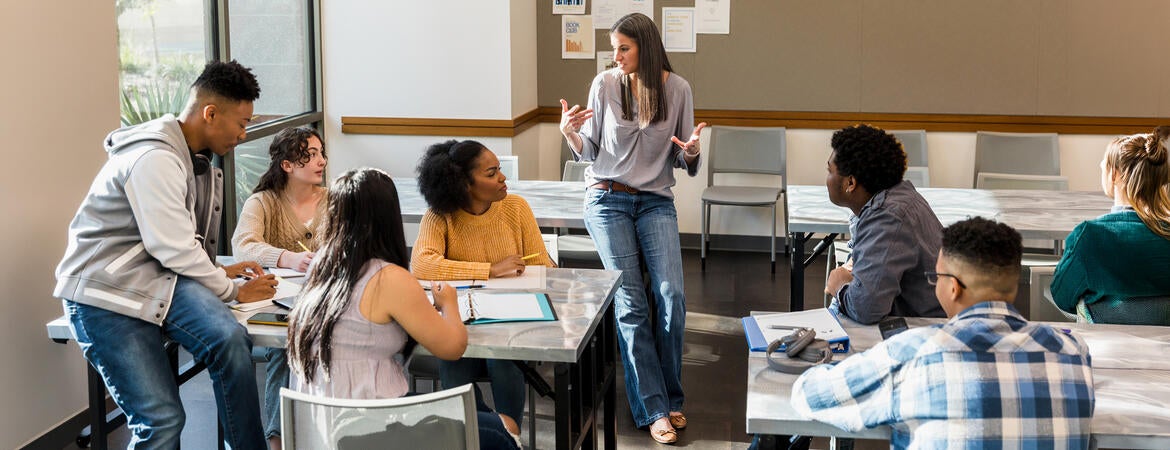

When social studies students delve into issues that affect their communities and discuss them in class, they are more likely to consider other people's points of view and are generally more interested in voting and in other ways to participate in civic life.
Those are among the findings of a sweeping study of Chicago Public Schools students led by UC Riverside education scholars. The researchers found that students who had opportunities to investigate issues relevant to their lives and communities reported greater interest in civic activities such as voting, attending public meetings, and volunteering. The students also were more interested in considering the views of people whose perspectives differed from their own.

Published in the journal Theory & Research in Social Education, the findings are based on surveys of more than 41,000 middle and high school students across 603 Chicago Public Schools campuses.
Joseph Kahne, a distinguished professor and associate dean at the UCR’s School of Education and a co-author of the study, said students become more engaged when teachers encourage them to investigate current societal issues and connect lessons to their own lives.
“These are the kinds of experiences that invite students to think, question, and connect,” Kahne said. “What’s striking is that when students learn about people like themselves, it doesn’t narrow their perspective — it actually expands their interest in people who hold different views.”
Benjamin Bowyer, a senior researcher with UCR’s Civic Engagement Research Group and the study’s lead author, said the level of student engagement stood out.
“Students who had more opportunities to explore questions and discuss issues relevant to their own interests and experiences reported that their classes were more meaningful and important to them,” Bowyer said. “That kind of engagement is critical for deeper learning.”
The research focused on two approaches designed to make social studies classes more relevant and engaging. One, known as inquiry-based learning, encourages students to ask questions, find reliable sources of information, analyze evidence, and weigh multiple perspectives rather than simply memorize facts.
The other, culturally responsive teaching, connects lessons to students’ identities, backgrounds, and lived experiences.
Together, these approaches are core features of a Chicago Public Schools instructional framework that centers student curiosity, discussion and real-world applications of knowledge. Called the Social Science Culturally Responsive Inquiry Arc Framework, it treats students as active participants in a pluralistic democracy rather than passive recipients of information.

“This unique instructional framework helps shift teaching and learning in social science in ways that allow students to connect their identities and communities to content,” said Yamali Rodriguez-Gruger, director of the Social Science Department for Chicago Public Schools.
“Through a culturally responsive inquiry process our students identify the relevancy of the content to their own lives, investigate complex issues and, together, consider ways to enact change. These findings show it pays off,” she said.
The study found that such classroom experiences can have important consequences for students both inside and outside the classroom.
The study also addresses a contentious debate surrounding culturally responsive teaching. Critics have argued that focusing on students’ identities or cultural backgrounds may divide classrooms or limit exposure to broader perspectives.
Kahne said the data suggest the opposite.
“Students who experienced these kinds of learning opportunities weren’t just more engaged — they were more interested in hearing and understanding perspectives different from their own.”
That combination of greater civic interest and openness to other viewpoints offers a hopeful counterpoint to concerns about growing polarization, Kahne said.
The research is based on a two-year study conducted in 2022 and 2023. Students were asked how often they experienced activities such as discussing multiple perspectives, investigating topics using evidence, and learning about people who shared their backgrounds. Researchers then compared their responses with measures of classroom engagement and civic attitudes over time.
Because the researchers followed students over multiple years, they could better assess whether classroom experiences contributed to changes in civic attitudes rather than simply reflecting interests students already held.
The findings also revealed disparities in access to these learning opportunities. Some groups, including English learners, reported fewer opportunities for inquiry-based or culturally responsive instruction, pointing to a need for more equitable implementation.
The evidence from Chicago Public Schools shows that “when you put identity, community, and relationships at the center of instructional vision, students will experience core instruction that empowers them to connect, imagine, and act as ethical, critical actors who shape the world,” Rodriguez-Gruger said.