
Donatella Galella grew up in New York City, where she loved seeing plays and musicals.
“It was amazing,” she said. “I miss having theater so accessible.”
An associate professor of theatre, film, and digital production at UC Riverside, Galella recalls attending as many as 100 performances a year when she was a graduate student at The Graduate Center of the City University of New York.

In 2012, she saw the Broadway revival of “Anything Goes” and enjoyed the performance so much that, six months later, she took her sister to see it. The second time around, however, she felt a discomfort she hadn’t experienced before and left the theater feeling troubled.
Cole Porter’s musical comedy, which first opened in 1934, is set aboard an ocean liner, where a young stowaway schemes to win the heart of an ingénue engaged to an English aristocrat. Toward the end, several white characters impersonate Chinese characters, adopting stereotypical mannerisms, accents, and dress.
The depictions struck Galella, who is of Italian and Chinese descent, as racist. From that point, her enthusiasm for Broadway began to give way to a more critical perspective. She became increasingly aware of racial stereotyping of Asian characters onstage as well as racial disparities in casting.
In her forthcoming book, she coins the phrase “feeling yellow” to describe the profound sense of anger, sadness, and racial alienation Asian Americans can feel when encountering yellowface: the use of makeup, costumes, gestures, and accents by non-Asian performers to portray characters of East Asian descent. The reaction can feel particularly acute when other audience members appear to be enjoying the show, she said.
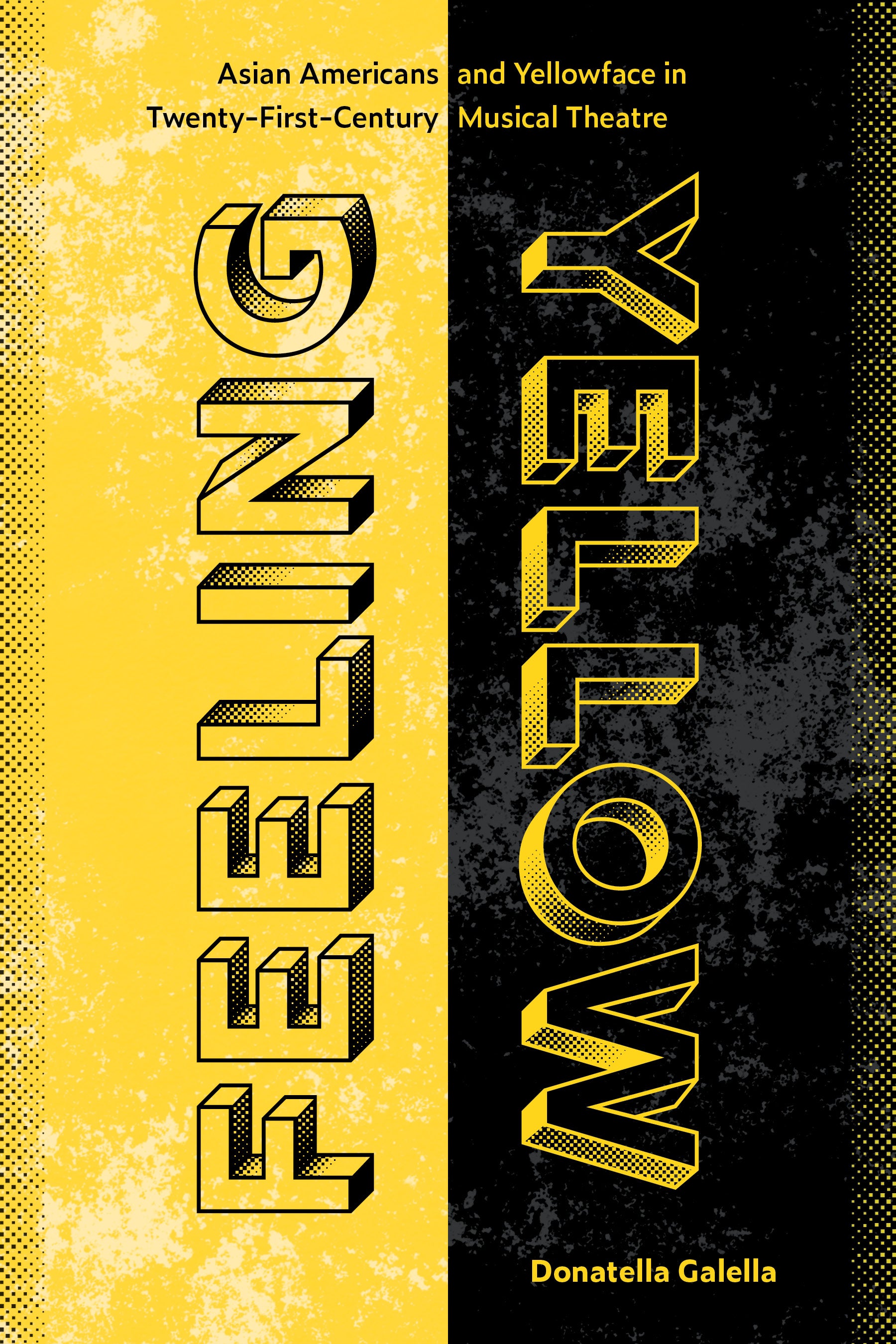
Galella discussed the book, “Feeling Yellow: Asian Americans and Yellowface in Twenty-FirstCentury Musical Theatre,” due out tomorrow from University of Michigan Press, and its inspiration in a recent interview with UCR News. (“Feeling Yellow” is open access; an online version can be read for free by clicking a link on the book page once the work is published.)
You grew up loving Broadway musicals, but in your book you describe a complicated relationship with them. What changed?
Galella: I kept encountering yellowface in productions. I might have been enjoying the story, songs, and dancing, not thinking about myself at all. Suddenly, I’m made painfully aware of my own racial identity and these ongoing inequalities. Feeling yellow encompasses the sadness, the anger, and that sudden reminder of racialization. It’s a theory I developed to explain how our emotional reactions to performances can be deeply related to racial identity. But those feelings don’t have to remain negative. We can use them to move other people — to help them feel with us and build solidarity against harmful representation.
You argue that yellowface persists partly because Americans don’t recognize anti-Asian racism as a systemic problem. Why have stereotypes of Asian people remained more acceptable in situations where other racial caricatures might provoke outrage?
Galella: There are several factors. Polling data show that most Americans don’t think anti-Asian racism exists on a systemic basis. They might recognize a slur or a racist gesture but not patterns of persistent inequality. One reason is the model-minority trope: the belief that Asian Americans excel, especially economically, and therefore don’t suffer penalties. It can seem more acceptable to mock Asian Americans, deny them opportunities, or perpetuate stereotypes because people assume the group is doing well.
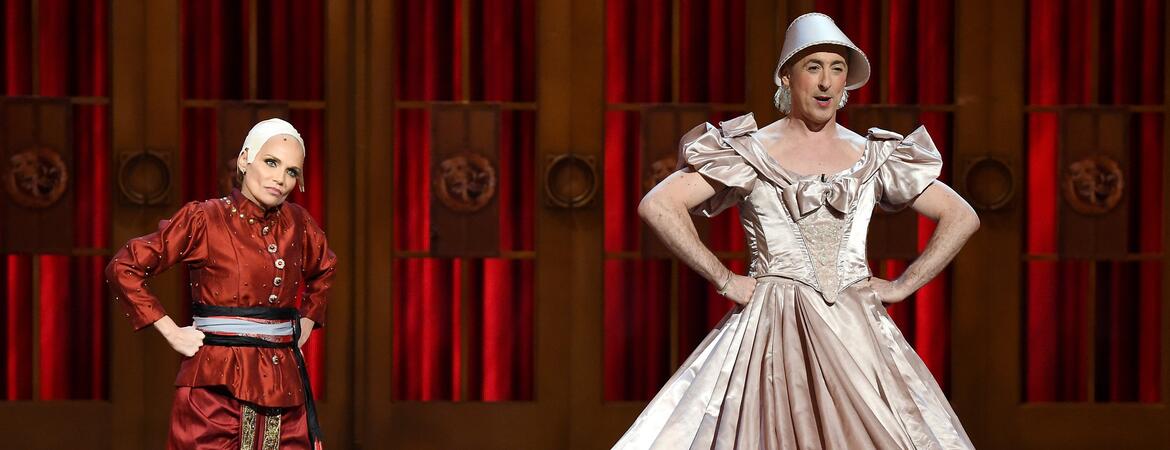
Your book opens with the singer and actress Kristin Chenoweth impersonating the character of the king of Siam, from “The King and I,” at the 2015 Tony Awards. You call the performance yellowface even though she wasn’t wearing makeup to appear Asian. Why?
Galella: We often think of yellowface as yellow bronzer, taping up the eyes and drawing lines to make them look more slanted, or using certain wigs and hairstyles. We sometimes think of blackface in the same narrowly visual way. But racial impersonation or minstrelsy is not just about makeup. What I call “yellowface without yellowed faces” can involve costumes, props, gestures or movement: holding fans or swords, shuffling with one’s hands inside long sleeves, or performing a finger-pointing dance associated with Chinese people, even though Chinese people don’t dance that way.
What does that moment at the Tony Awards tell us about how racial impersonation has changed?
Galella: In the past, people were more accustomed to heavy makeup. Mickey Rooney in “Breakfast at Tiffany’s” is one of the clearest examples, and now we look back on it with some shame.
The overt makeup appears much less often in 21st-century productions. We came to recognize it as too obviously racist. But yellowface became subtler and therefore less clearly objectionable. That shift aligned with multiculturalism and ideas of a supposedly post-racial society. Someone can say, “I’m just wearing a kimono” or “I’m just holding a samurai sword.” There is a sense of innocence or racial disavowal around gestures and objects that are less visibly offensive but can still constitute yellowface.
You argue that the qualities that make musicals pleasurable — the music, humor, spectacle, and shared emotional experience — can also make audiences less receptive to recognizing racism. How does that work?
Galella: When I watch a good musical, I feel so alive and happy. It’s my favorite place to be. Sometimes, we’re swept away by the music and don’t fully register what the lyrics say or the implications of a situation. The music is working on us in a powerful emotional, embodied way. It might take a conversation after the show to reflect critically on what was happening.
Another difficulty is that when somebody points out a problem in a musical we love, we can become defensive. We feel as though they’re calling us bad because we like something problematic. Then we deflect and accuse the critic of ruining everything, of being a killjoy. I think it’s best when we can acknowledge our genuine pleasure in musicals and engage with the criticism at the same time.
Acting often involves portraying someone with a different identity or life experience. Dev Patel has played David Copperfield, and Gemma Chan has portrayed Bess of Hardwick. If actors of color can play historically white characters, why shouldn’t white actors play Asian characters?
Galella: We’ve seen people of color play historically white figures. I think it’s incredible to have opened those doors. If we had true equity — if the power imbalances and stereotypes were gone — we could embrace all the imaginative possibilities of theater. It’s make-believe; it doesn’t have to be realistic. People could cross all kinds of boundaries involving identity and bodies.
But that’s not where we are. Actors of color are still underrepresented relative to their share of the acting pool and the population. They’re often seen as suitable only for roles matching their own identities, rather than canonical, classic, or substantial parts. We need to keep redistributing opportunities before we can get to a point where the exchange can be reciprocal.
There’s also a double harm when a role written for a character of color is a stereotype and is then given to someone who already has more privilege. It reinforces the stereotype while reproducing the inequality.
So, in a genuinely equitable society, could you imagine white actors playing Asian characters?
Galella: I think one day, in a different power context, that could make sense because there wouldn’t be the same inequality or pain. It’s like making jokes: You can punch up, but you don’t want to punch down. If we reach a truly equitable situation, then of course there can be equal opportunity.
Ken Watanabe, who is Japanese, played the king of Siam in the 2015 Broadway revival of “The King and I.” Is it acceptable for an actor of one Asian ancestry to portray a character of a different Asian ancestry or nationality?
Galella: The Asian American movement was built on recognizing connections among our struggles. People who target us for racist violence generally don’t stop to determine our specific ethnicity. Audiences also tend to read bodies onstage as part of a broader racial group rather than sorting everyone by nationality. Ultimately, I think it’s acceptable for Asian actors to play across Asian ethnicities, and for us to have one another’s backs. At the same time, we should direct opportunities toward underrepresented groups, like Southeast Asian Americans, and recognize the value of specific cultural knowledge that actors bring to their characters.
You describe “Thoroughly Modern Millie” as containing “ironic racism,” in which exaggerated stereotypes are presented to satirize racism itself. But you argue this still poses a problem. Why?
Galella: Even when artists intend to satirize or undermine racism, they can’t ultimately control how audiences receive their work. If you’re still putting a racist stereotype onstage or onscreen, some people will laugh at the surface image without recognizing the layers of critique. That’s part of the risk of irony: It operates on multiple levels. Even well-intentioned artists can produce hurtful effects that they didn’t anticipate.
With a variety of cultural tastes, backgrounds, and world views, Asian Americans are unlikely to all take offense from the same character or story line. How does someone decide what qualifies as offensive in a stage production?
Galella: It’s difficult because people disagree. That’s why I try to present multiple perspectives in my research. Actors who play stereotypical roles sometimes believe they’re doing progressive work. Others acknowledge that they need health insurance, a credit on their résumé, or a job, and they’re trying to bring dignity to the part they’re offered.
As a scholar, I have a little less at stake than the performers who make a living from the art. I can point out what a portrayal is doing, the effects it has, and the patterns it reinforces, while recognizing that the actor may have a different intention or practical need. Those things happen simultaneously. They don’t cancel each other out. Multiple people can be right about different aspects of the same situation.
In musicals such as “The King and I,” you argue that troubling assumptions about Asian cultures are embedded in the story, not just the makeup or casting. Can revisions fix them, or are some shows too compromised to keep performing?
Galella: Some shows have a troubling fundamental premise. When we restage them professionally, we’re implicitly endorsing their message, so we need to be careful. There have been many revisions that try to make older musicals less racist, more inclusive, and more appealing to contemporary audiences without compromising the basic story.
I think changes to “Anything Goes” can work without destroying the Cole Porter songs or the madcap comedy. At the same time, it’s a little sad that the newest revision removes the Chinese characters. Some shows can be edited sufficiently. But if the whole premise is that a babysitter has to teach the king of a country how to govern because he’s so childish and uncivilized [“The King and I”], I don’t think you can really fix that.
David Henry Hwang’s “Soft Power” reverses the dynamics of “The King and I,” with Asian American performers portraying white Americans in stereotypical ways. Is the aim to make white audiences experience something like the discomfort Asian Americans have historically felt?
Galella: Yes. For me, the show is trying to simulate “feeling yellow” for white Americans. The shoe is on the other foot: See how you like it. It can feel uncomfortable, but it can also prompt people to laugh at themselves and recognize, “Oh, this is what we’ve been doing to other cultures.”
It’s also very funny. I saw it three times in Los Angeles and once in New York, and I laughed so much. I had rarely felt so seen and alive in a theater.
A launch party for “Feeling Yellow,” featuring Galella in conversation with UCR dance professor Anthea Kraut, is scheduled for 3:30 p.m. Nov. 18 in Room 1111 of the Interdisciplinary South Building of the College of Humanities, Arts, and Social Sciences.
Top, Kristin Chenoweth impersonates actor Yul Brynner's look as the king of Siam, from his famous performances in the “The King and I,” at the 2015 Tony Awards, with Alan Cumming as Anna. (Getty Images/Theo Wargo)