
Hundreds of Venus-like planets could soon help determine why some worlds become sweltering greenhouse hellscapes while others remain capable of supporting life. But before answering that question, scientists first need to know how fast those planets are spinning.

The speed of a planet’s rotation helps determine how energy from a star, like the sun, moves around a planet and shapes its weather patterns, as well as interactions between its atmosphere and oceans, if the planet has them. Without knowing the true rotation rate, scientists trying to model an alien planet’s climate are missing a fundamental piece of information.
“People tend to overlook planetary rotation, but it is absolutely key to understanding a planet’s climate,” said Stephen Kane, a planetary astrophysicist at the University of California, Riverside.
In a new Astronomical Journal paper, Kane warns that measuring the rotation of a distant planet is not straightforward. Astronomers could believe they are measuring the rotation of the planet itself when they are actually measuring winds racing through its atmosphere.
Venus is the cautionary tale. The planet takes 243 Earth days to rotate once on its axis, but its upper atmosphere circles the planet in only about four days, making Venus appear to rotate roughly 60 times faster than it actually does.
“This is what people originally thought about Venus,” Kane said. “If you just look at the atmosphere of a planet like Venus, you’d think it rotates once every four days, and you’d be wrong by almost two orders of magnitude.”
For planets orbiting other stars, astronomers generally cannot see a solid surface that would reveal how quickly the planet itself is turning. Instead, measurements may rely on changes visible in the atmosphere. Kane’s paper is a warning that those atmospheric movements do not necessarily reveal the rotation of the world underneath.
The problem, however, is solvable. Kane proposes observing the same planet at multiple wavelengths, including infrared wavelengths that allow scientists to probe deeper layers of its atmosphere.
On Venus, wind speeds decrease closer to the surface. By comparing measurements at several atmospheric depths, scientists could construct a model of the changing wind speeds and use it to better estimate the rotation rate of the planet itself.

Knowing how to do this could soon become much more important. In a separate, recently published paper, Kane and colleagues predict that a new European Space Agency mission, the PLATO mission, will discover hundreds of Venus-like planets, providing an unprecedented opportunity to determine how common worlds like our planetary neighbor really are. That paper appears in the Publications of the Astronomical Society of the Pacific.
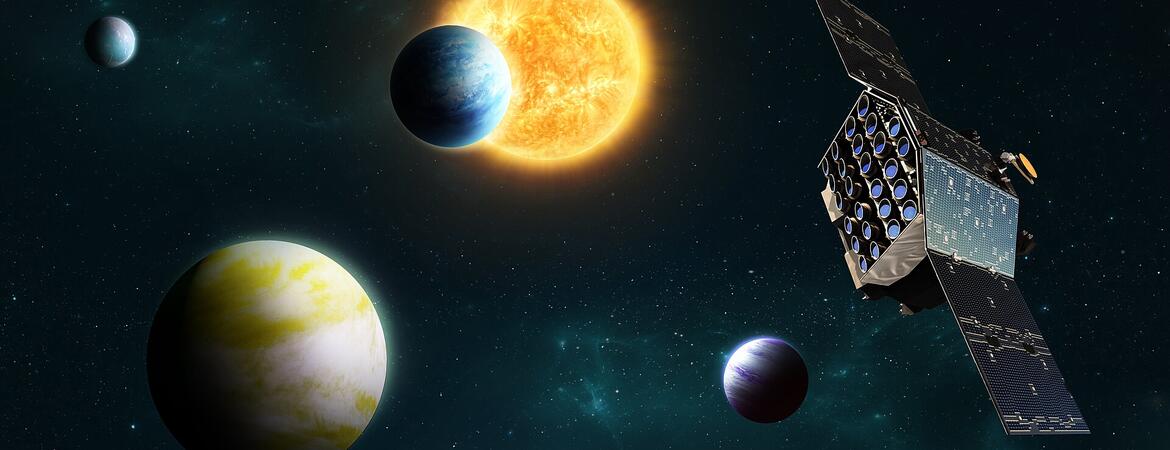
The PLATO mission, scheduled to launch in March 2027, will search a large portion of the sky for planets passing in front of their stars. Unlike previous planet-hunting missions, it will spend years observing some regions, making it sensitive to planets that take longer to complete their orbits.
Just as importantly, many of the planets PLATO finds will orbit relatively bright stars. That will make them better targets for follow-up observations with instruments such as the James Webb Space Telescope, which can examine their atmospheres.
The researchers predict PLATO will find several hundred Venus-like planets. That would give scientists something they have never had before: a large population of similar planets that can be compared with Venus.
“We’ve learned a lot about Venus itself, but there is still so much we don’t understand about its history,” said Emma Miles, co-author on the Astronomical Society paper and UCR doctoral student. “Exo-Venus candidates, which are Venus-like planets in other solar systems, are going to play a huge role in filling in that knowledge gap.”
Miles said she is excited that PLATO will not only find more exo-Venus candidates but also contextualize the systems where they are discovered.
“For example, PLATO will be able to measure the ages of the host stars, which will allow us to determine where a given exo-Venus sits in its own evolutionary history, and to further explore the boundaries of habitability,” Miles said.
Comparisons between Venus-like planets in other solar systems and Venus itself could help answer one of the biggest questions about our neighboring planet: why did Venus, a world similar in size to Earth, develop a crushing atmosphere and temperatures hot enough to melt lead while Earth remained habitable?
If scientists examine 100 Venus-like worlds and discover that most are also extremely slow rotators, that could indicate slow rotation is an important factor in turning planets into greenhouse worlds. If those planets have a wide range of rotation rates, scientists will have reason to look more closely at other explanations.
The same principle applies in the search for potentially habitable planets. Earth’s roughly 24-hour rotation helps distribute solar energy around the planet and shapes the atmospheric and ocean circulation systems that regulate the climate. Accurately measuring rotation on distant Earth-like worlds could therefore improve scientists’ ability to predict whether those planets can maintain habitable conditions.
“Venus is a giant mystery,” Kane said. “To understand it, we need to see Venuses in other systems and see how they changed through time. Rotation is a huge piece of that puzzle, and we need to be careful that what we think we’re measuring is really the rotation of the planet.”
(Cover image: artist rendering of the PLATO mission: European Space Agency)