
Two UC Riverside computer scientists are joining projects selected for federal funding under the U.S. Department of Energy's Genesis Mission, an initiative that seeks to harness artificial intelligence to accelerate scientific discovery.
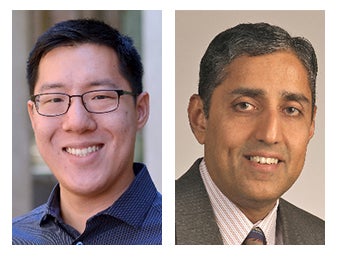
Associate Professor Daniel Wong will lead a research team seeking to improve the speed and accuracy of quantum computing, while Distinguished Professor Kadangode “K.K.” Ramakrishnan will join a team led by Oak Ridge National Laboratory to improve how scientific data and specialized equipment are shared among laboratories and researchers collaborating across the country.
The DOE recently selected 278 Genesis research projects nationwide to share $293 million in funding. Both projects involving UCR faculty and students were selected for Phase I awards, which range from $500,000 to $750,000, according to the DOE.
The Genesis Mission brings together artificial intelligence, high-performance computing, and scientists from universities, national laboratories, and industry. The DOE says the initiative aims to double U.S. scientific productivity while tackling challenges in advanced manufacturing, biotechnology, critical materials, nuclear energy, and quantum information science.
Making quantum computers more reliable
Wong is leading a project that would use AI to overcome one of the biggest obstacles to large-scale quantum computing: correcting errors fast enough to keep calculations on track.
Quantum computers are highly susceptible to noise and other disturbances that introduce errors. Correcting them requires conventional computers to continuously interpret measurements from quantum processors and determine what went wrong. In superconducting quantum computers, that decoding may eventually need to occur within about 1 microsecond — one-millionth of a second.
Wong's team plans to develop AI-based error decoders that combine realistic models of quantum computer noise with high-fidelity simulations. The resulting data would train powerful AI models to recognize error patterns and predict the corrections needed.
"Reliable and fast error correction is one of the key capabilities needed to make large-scale quantum computing practical," Wong said. "Our goal is to use AI to improve both the speed and accuracy of that process."
Because sophisticated AI models normally require too much computing power to operate within such an extraordinarily short control cycle, the researchers will use a technique called "distillation." It transfers what a large, powerful AI model has learned into a smaller, faster model.

The Phase I goal is to achieve decoding within 5 microseconds while outperforming conventional approaches at suppressing errors, with a later goal of reaching the 1-microsecond threshold. The project includes researchers from UCR, USC, Sandia National Laboratories, and BlueQubit.
Building smarter networks for AI-driven science
Ramakrishnan is participating in a separate project aimed at moving enormous amounts of scientific data more quickly and reliably among laboratories and computing facilities, thus enabling scientists to share experiment resources across different facilities.
Called Science-Aware Network Operations for Research Networks, or SciNet, the project is led by Oak Ridge National Laboratory, with UCR, Caltech, and HPE Labs as partners.
SciNet is being designed for an emerging generation of AI-driven, or "self-driving," laboratories in which robotics, AI, real-time data analysis, and automated feedback work together across distant locations. Existing research networks can become bottlenecks when these systems need to rapidly exchange data.
"The idea is to orchestrate experiments across different national laboratories," Ramakrishnan said. "One lab may have the needed storage, another may have the instruments needed for a particular experiment. The challenge is bringing all of that together, so that many experiments can proceed concurrently."
SciNet would make those networks more intelligent and adaptable, allowing them to anticipate the needs of scientific projects and adjust how data moves to avoid congestion. The goal is to reduce delays or even failures of workflows, and ultimately speed scientific discovery.
Ramakrishnan's UCR group will focus on improving the network protocols that determine how data is transported and routed through networks. Those improvements are intended to enable AI-enabled agents managing the scientific workflows to overcome bottlenecks, shorten experimental delays, and reduce workflow failures.
"The theme of the Genesis Mission is to make science progress faster by efficiently sharing distributed experimental resources among scientists," Ramakrishnan said.