
California cities could help ease the housing affordability crunch by providing property owners with preapproved building plans for granny flats, duplexes, and other smaller housing developments, a UC Riverside study has found.
Such plans saved builders an average of $10,300 in design and related costs and shortened the design and permitting process by about 53 days, according to a survey of California cities by UCR's Center for Community Solutions, part of the School of Public Policy.

Cities also reported preapproved plans were processed an average of 2.8 times faster than conventional building plans.
"Most cities responded affirmatively that they have seen some time and cost savings," said Kristen Kopko, research manager at the center and lead researcher on the study.
The findings suggest that preapproved plans could help expand what housing experts call "missing middle" housing — duplexes, townhouses, bungalow courts, and other developments that fall between single-family homes and large apartment buildings.
These smaller developments can provide more housing within established neighborhoods. But they often face substantial architectural, engineering, and permitting expenses without the economies of scale available to large apartment projects.
The study examined the city of Riverside's new program offering preapproved plans for duplexes and bungalow courts, which consist of small homes arranged around a shared courtyard.
Approved by the Riverside City Council in June, the program aims to reduce development costs and uncertainty by completing much of the design and technical review before property owners apply for building permits.
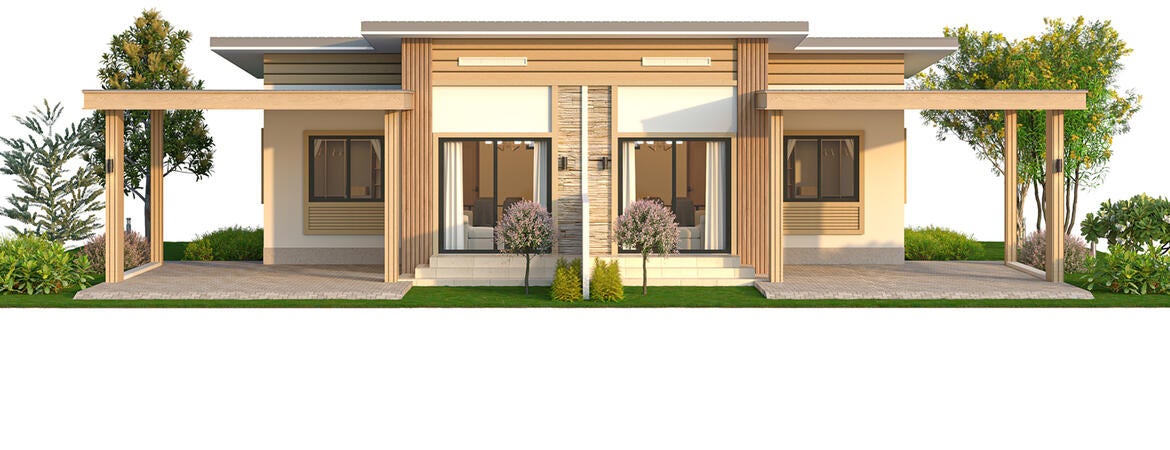
The city offers plans for a duplex and a bungalow that can be repeated around a shared courtyard.
The duplex features two units of about 1,300 square feet each, with three bedrooms and two bathrooms. The bungalow is 1,000 square feet, with two bedrooms, two bathrooms, and a private patio.
Both designs include a ground-floor bedroom and bathroom to accommodate residents whose mobility or household needs may change.
Architectural, structural, mechanical, electrical, and plumbing components have already undergone review, eliminating some of the work normally required for each project.
The plans do not provide automatic permission to build, however. Property owners must still meet zoning, parking, utility, grading, and other requirements specific to their properties. Changes to the designs may require additional review.
The program grew out of discussions among community leaders, housing developers and other participants in a regional Housing Policy Leadership Academy. Riverside subsequently developed the plans with input from residents, technical advisers, and other partners.
To evaluate the approach, UCR researchers examined Riverside's planning documents, compared housing initiatives across the country, and surveyed 89 California jurisdictions. Fifty-nine responded.
Most of the preapproved plans offered by those communities were for accessory dwelling units, or ADUs — smaller homes commonly built in backyards and known as granny flats, backyard cottages, or casitas.
Such homes can accommodate aging parents who want to live near family members, college students, or young adults beginning their careers.
The responding communities reported about 500 ADUs permitted or constructed using preapproved plans.
Only four jurisdictions offered preapproved designs for housing beyond ADUs, and just one reported permitting such a project — a triplex.
The researchers also found substantial differences in how cities operated their programs. Some provided publicly funded plans at no charge, while others offered privately owned designs that property owners had to purchase or license.
Those differences affected potential savings. Although cities that could estimate costs reported average savings of $10,300, the amounts ranged from a few thousand dollars to $45,000.
The researchers cautioned that savings reported for ADUs cannot necessarily be expected for larger housing projects.
Riverside's plans are intended to encourage housing suitable for middle-income households, but the homes are not income-restricted. Lower design costs also do not guarantee affordable rents or sale prices.
The next test is whether Riverside's preapproved plans lead to completed homes. Researchers recommend tracking how often the plans are used, how much money and time they save, and whether projects ultimately reach construction.
Kopko said the approach could be especially useful in communities with vacant or underused land suitable for development within existing neighborhoods.
"If you're a city that has a lot of vacant land that's rife for infill development," she said, "a plan like this to maybe try to fill some of those vacant lots or remove blight or revitalize an area ... could be very useful."
The study's title is "Preapproved Housing Plans for Missing Middle Housing: A Case Study of the City of Riverside." In addition to Kopko, its authors are Justine Ross, executive director of the Center for Community Solutions; Jayden Li, an intern for the center; and Qingfang Wang, the center's faculty director.