OFFICE HOURS
Charting culture through media
An international career in television and scholarship informs Tabassum “Ruhi” Khan’s study of societies in transition
By Iqbal Pittalwala | Photos by Stan Lim
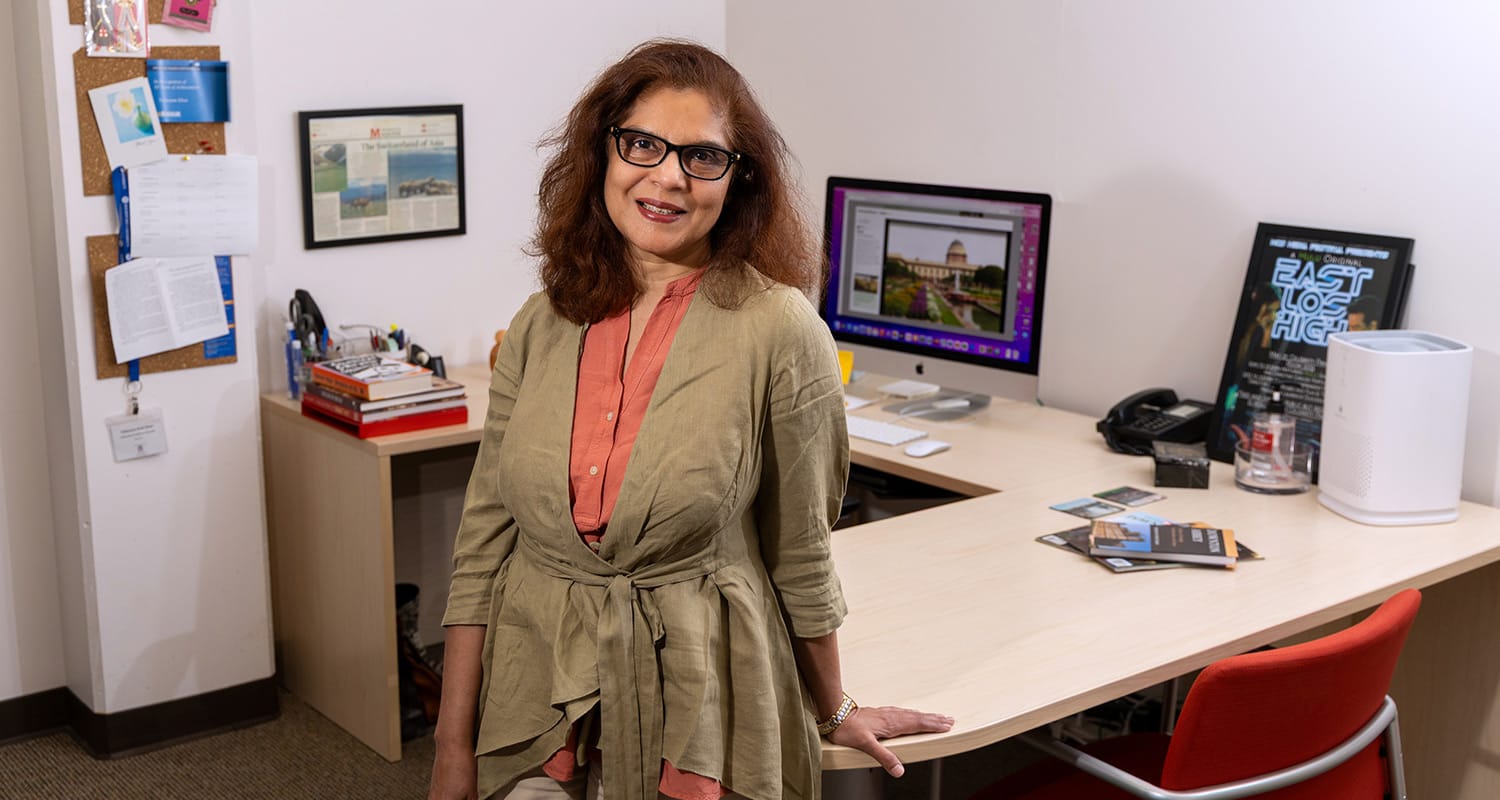
A t first glance, Tabassum “Ruhi” Khan’s office looks like a small archive of travel. Her desk and shelves hold objects from around the world, each marking a place where she’s lived, studied, or worked. Together, they trace a journey shaped by movement across cultures — experiences central to Khan’s scholarship on intersections of media, globalization, identity, and politics.
Her interest in these topics began almost accidentally. Growing up in Kuwait from about age 9 to 19, she was a “huge TV addict,” spending hours each day glued to the television set. Her life changed abruptly in 1990, during the Gulf War, when her family moved back to New Delhi, India, the country of her birth.
“By then, most university admissions in India had closed, but one entrance exam for a media school remained open,” said Khan, now an associate professor of media and cultural studies at UC Riverside. “I took the test with no particular expectations, did extremely well, and eventually got a master’s degree.”
Khan had once imagined pursuing a more conventional path, such as clinical or social psychology, but the media program proved transformative. It remains, in her view, the best education she has received.
“Arriving in India from Kuwait meant witnessing a pivotal moment in India’s media landscape,” she said. “Within a few years in the early 1990s, the television industry expanded dramatically from a single channel to dozens. Watching this shift from scarcity to abundance made me aware of how quickly media systems can change. It sharpened my curiosity about how profoundly such transformations affect audiences and culture.”
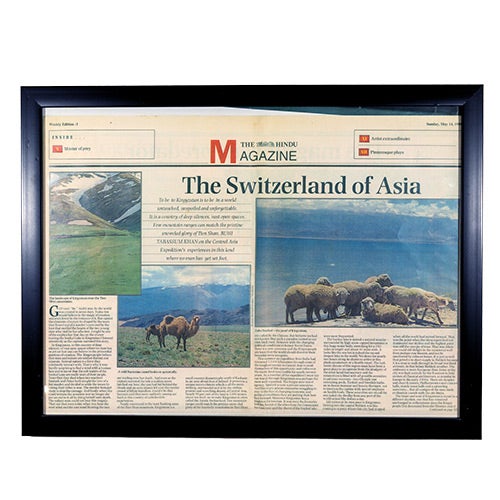
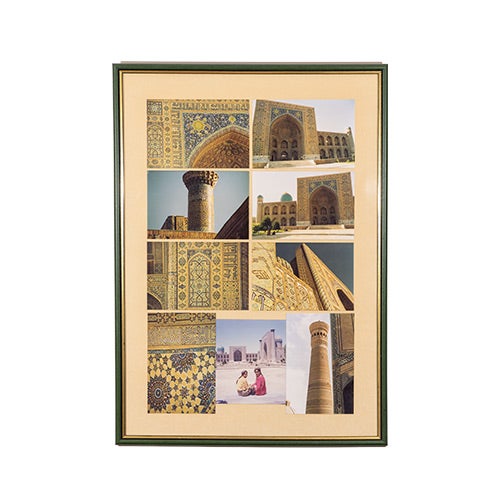
One of Khan’s first major projects involved working on a documentary about the Silk Road, the network of ancient trade routes that connected Asia, Europe, and Africa.
“I conducted research, helped develop the marketing pitch, and spent three months traveling along the Silk Road during production,” she said. “When the project ended, however, I realized that although I had helped make the film, I knew little about how films were financed, distributed, or marketed.”
The documentary sold for a substantial sum, but her own compensation was modest. The experience prompted questions that would later shape her career: how media content circulates, who controls distribution systems, and who ultimately benefits.
Khan went on to pursue a second master’s degree, in television production and management, at Syracuse University through a Fulbright scholarship. There, her studies focused on the business and distribution side of media — programming, marketing, scheduling, and the logistics of launching television channels — and included an internship researching international markets for Discovery Channel International.
After completing her studies at Syracuse, Khan returned to Delhi. One day, while walking past the offices of the major media company Star TV, she decided on impulse to drop off her resume. Soon after, she was offered a position.
The timing proved ideal: the company was preparing to launch a direct-to-home satellite platform and needed someone to research programming strategies and media markets, she said.
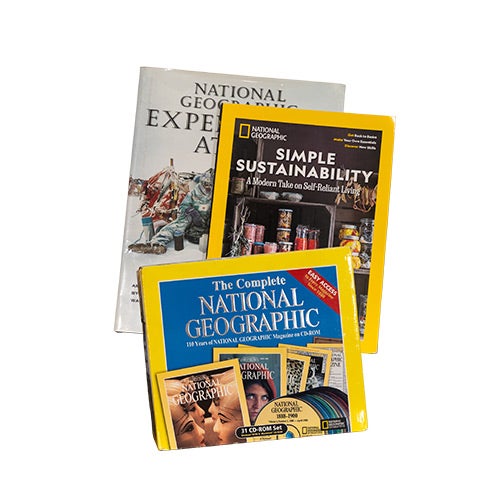
In 2000, Khan was hired as head of programming for National Geographic, which had recently launched in Asia. In its earliest days, the Delhi team consisted of only four people: her boss, a secretary, the head of distribution, and herself. Together they built the channel from the ground up.
“Those years in industry left a lasting mark on my approach to teaching and scholarship,” she said. “Launching a television channel involves asking questions that resemble those posed in academic research: Who wants this content? What already exists to meet that demand? If something is missing, how can it be created?”
In 2004, Khan began doctoral studies at Ohio University. There, she focused her research on the rapid cultural transformations taking place in India and the ways media, public policy, and history shape these changes.
She joined UCR in 2008, where her research includes examining how Muslim identities evolve within global media environments. Khan’s 2015 book, “Beyond Hybridity and Fundamentalism: Emerging Muslim Identity in Globalized India,” explores how digital communication and media participation influence political consciousness among Muslim communities.
Her most recent book, “Downton Abbey: Politics of Nostalgia, Neoliberalism, and Empire,” published last November, analyzes the global popularity of the television series and explores how nostalgic portrayals of empire, class hierarchy, and social order resonate in an era of economic and political uncertainty.
“Audiences are drawn to Downton Abbey’s imagined world of civility, stability, and mutual responsibility — values many people feel are missing in contemporary neoliberal society,” Khan said. “The series’ debut in 2010, shortly after the global financial crisis, is significant: in moments of uncertainty, narratives that present stable social structures and meaningful relationships can feel reassuring.”
One of her goals as a teacher is to show students that media texts also carry political and economic assumptions. She has observed that when students analyze the narratives and images embedded in everyday media, they begin to recognize how deeply these cultural forms shape their understanding of the world.
Ultimately, the central question still driving Khan’s work grows out of her experience of India’s rapidly changing media landscape. Over time, she watched a country that once emphasized social responsibility and dignity for the poor shift toward a different set of values.
“It led me to wonder: did people in India change or did the images and narratives circulating through media gradually reshape how they think about politics, society, and their place within it?” she said. “Questions like these lie at the heart of why I study media.”