The Green Machine
New technology patented by UCR bioengineer Charles Cai is helping transform plant waste into sustainable fuels and high-end textiles
By David Danelski | Photos by Stan Lim
W hile he was an undergraduate at UC Davis, a professor challenged Charles Cai to think big: How could energy — the lifeblood of modern life — be delivered to the billions of people who still lack reliable access to it?
To answer the question, Cai considered an energy source available almost everywhere: plants. Where there are people, crops are grown to feed them, he reasoned. Beyond providing food, crops also generate vast amounts of agricultural waste — corn stalks, straw, and woody prunings from fruit trees — all rich in stored energy from the sun.
Determining how to tap this biomass became a passion for Cai that eventually led him to UC Riverside, first as a doctoral student and now as an associate research professor at the College of Engineering’s Center for Environmental Research and Technology (CE-CERT).
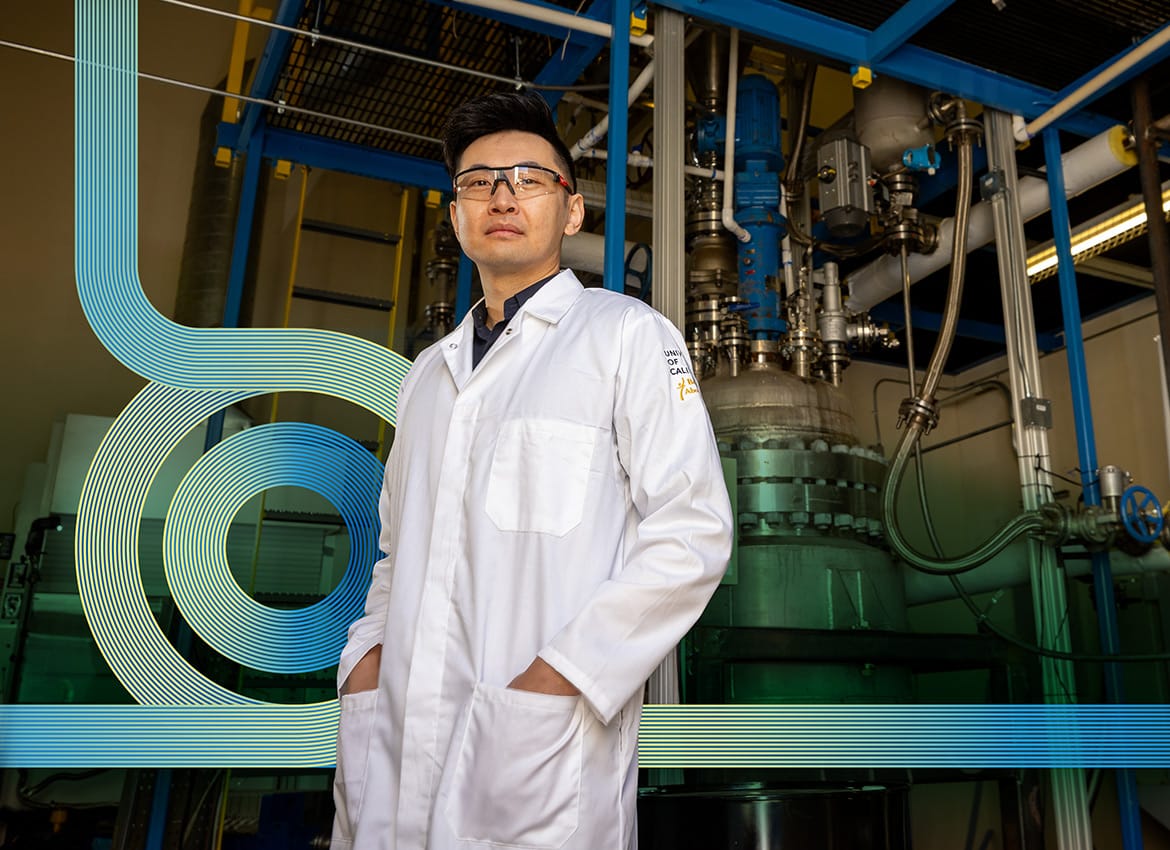
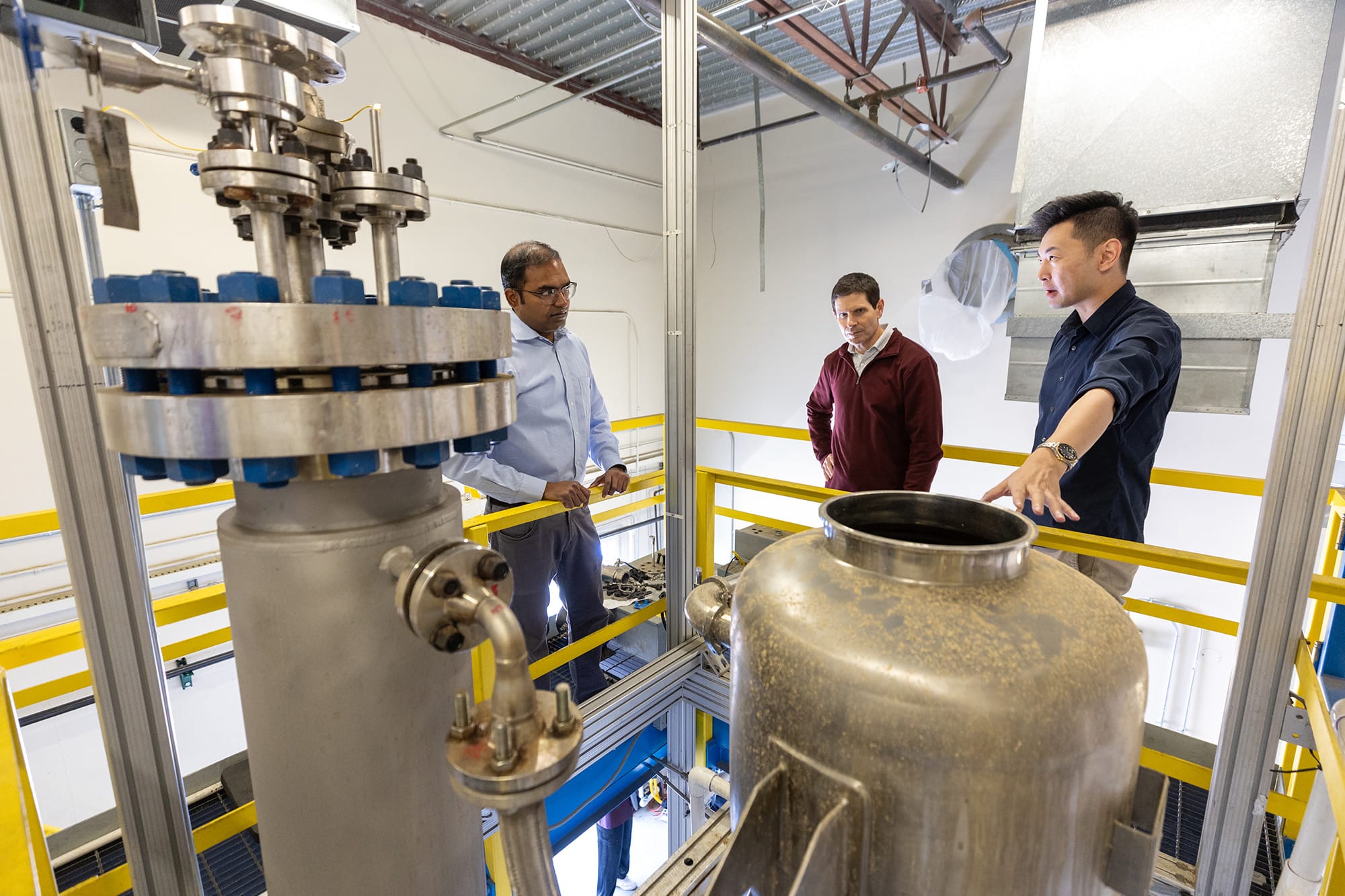
Cai recently oversaw the construction of a two-story facility at CE-CERT that demonstrates his patented biomass processing technology known as CELF — short for co-solvent enhanced lignocellulosic fractionation. This energy-efficient system of pipes, tanks, and heating elements turns plant waste into highly marketable precursors for fuels, textiles, construction materials, and other products.
The technology’s flagship application is the production of biofuels such as biogasoline, sustainable aviation fuels, and cleaner heavy marine fuels. As reported in a study published recently in the journal Energy and Environmental Science, CELF has the potential to supply sustainable, carbon-neutral aviation fuels to the market at around $3 per gasoline gallon equivalent — a measure of the amount of alternative fuel it takes to equal the energy content of one liquid gallon of gasoline. The current average cost for a gallon of jet fuel in the U.S. is more than $7.
In the realm of sustainable fashion, the high-quality dissolving pulp created in this process can be used to make rayon and lyocell fabrics for activewear favored by high-end retailers such as REI and Patagonia. The CELF process, compared with traditional kraft pulping methods, uses roughly half the energy and does so without significant environmental pollution.
The spark of these innovations, Cai explained, came during a heady brainstorming session in 2008 with UC Davis Professor Dewey Ryu when Cai was a student. A biochemical engineer, Ryu posed the question, “What’s one of the world’s biggest problems, and how can you solve it?”
After Cai settled on biological processes to produce renewable energy, Ryu handed him a thick textbook called “The Molecular Biology of the Cell” and asked him to write a report on each chapter — a valuable learning experience that took a full semester as he kept up with his other classes.
Cai had arrived at UC Davis in 2005 with help from a California governor’s scholarship. As a student at Washington High School in Fremont, he pursued interests in art, design, and mechanics, spending his time disassembling and reassembling electronic devices, building computers, and experimenting with robotics. He considered pursuing medical school, but an interest in winemaking led him to the university’s biochemical engineering department, where he delved into the science of fermentation — the natural process that turns sugars into alcohol.
At Davis, Cai learned about the challenges of deriving energy from plants — without having to wait millions of years for organic material to turn into crude oil or coal. One strategy is to ferment corn or other grains to make ethanol. But doing so would create another problem: farms would have to decide whether to grow crops for energy or food, a trade off that could lead to food shortages in resource-strapped regions.
Instead, he focused on the energy stored in agricultural waste from a variety of food crops: corn stalks, known as stover; the leftover fibrous material from sugarcane called bagasse; brush clearings from forest management practices; and fruit-tree prunings from orchards, among other sources.
All this material contains cellulose — long chains of glucose molecules that can be converted into fuel. But Cai soon encountered a challenge long faced by scientists: the energy-rich cellulose is locked inside matrices of cement-like lignin, making biomass chemically and physically resistant to breakdown.
Delving into the academic literature, Cai uncovered various biomass treatment strategies, and one scholar stood out as a leader in the field: Charles Wyman, a UCR professor and CE-CERT faculty researcher who years later would become Cai’s mentor.
A Hope and a Prayer
After graduating from UC Davis, Cai joined a Bay Area biotech startup called Amyris, which was capitalizing on newly discovered genetic-engineering techniques to create microbes that produce useful compounds for pharmaceuticals and other applications.
“The whole idea is that you could make a business out of re-engineering a microbe in order to give it instructions to produce something that you want it to produce,” Cai said.
Amyris had genetically engineered a strain of yeast to convert plant sugars into farnesene, an organic compound that, at the time, was being explored to make renewable diesel.
For this work, Amyris had followed the research of Wyman, a world leader in biomass innovation. Cai’s boss asked him if he had heard of Wyman, saying Wyman was addressing the food-versus-fuel debate, using pretreatment to enhance the ability to make fuel from plant waste rather than food crops. Cai’s ears perked at the question. It was the second time Wyman’s name had come up as a leader in the biomass energy field, and he emailed Wyman to ask about the possibility of joining his laboratory.
The response was initially lukewarm. Wyman wrote back saying he had no open positions in his lab, but if Cai became a UCR graduate student, he would consider him if one became available.
Cai enrolled at UCR as an engineering doctoral student, focusing on required coursework his first year. By summer, however, Wyman still had no openings for graduate student positions, which are typically funded by research grants. But not all hope was lost. Wyman allowed Cai to work in the lab — the Aqueous Biomass Processing Group — during the summer without pay so he could test some of his ideas.
“I started to develop my own pretreatment setup, and I ran a couple of reactions and got some pretty decent results, unexpectedly,” Cai said. His work caught the eye of Rajeev Kumar, a research professor in Wyman’s lab, who suggested applying for a federal grant to further develop Cai’s treatment method, a long shot Cai considered “a hope and a prayer.”
The grant application languished for months at the U.S. Department of Agriculture (USDA), and Cai needed a way to support himself, so he returned to work for Amyris as a graduate intern. Just two weeks before he would have had to abandon his graduate studies, the USDA approved a $200,000 grant. Cai could finally pursue his dream of tapping biomass for fuel and other products under the mentorship of Wyman.
Waste Not, Want Not
Deriving energy from biomass requires separating the carbon-chain-rich cellulose sugars from lignin, a complex natural polymer that gives plant cell walls rigidity and allows trees to stand upright. Once the cellulose is freed from lignin, it can be hydrolyzed into sugars, which can then be fermented to produce ethanol fuel or, with the help of genetically engineered microbes, other types of biofuels.
As a graduate student, Cai sought to simplify these processes by using a low-cost and recyclable solvent capable of extracting cellulose fibers into a pulp while simultaneously separating lignin at mild reaction temperatures that reduce energy consumption and improve yields.
Through dogged laboratory work, Cai found that a previously overlooked solvent called tetrahydrofuran, or THF, outperformed many other solvents. But choosing the solvent was only one of many variables he had to test.
“A lot of science obviously has to do with your own knowledge,” Cai said. “But science research is also a lot of luck. And the only way to bring Lady Luck onto your side is repetition.”
Cai ran more than a thousand reactions, each taking about six hours, to develop the CELF process. These trials consumed his graduate student years.
With each major development, Cai, at Wyman’s urging, applied for additional grants, receiving more funding to continue his research — including about $3 million from the U.S. Department of Energy and USDA. Jeremy Smith, a professor at the University of Tennessee Knoxville and director of the Oak Ridge National Laboratory Center for Molecular Biophysics, also donated supercomputing time to theoretically confirm THF’s unique behavior and superiority to other solvents.
“The goal is to take something that’s normally a liability — something people burn or throw away — and turn it into something valuable.”
When Cai was ready to publish his methods, Wyman advised him to first visit UCR’s Office of Technology Partnerships to help him with patenting the technology. Cai also formed a company called MG Fuels (MG is an acronym for “More Green”) with his business partner Michael Gurin, which licenses the CELF technology from UCR. After completing his doctoral degree, Cai was hired by UCR as an assistant research engineer.
Cai explained that part of CELF’s appeal is its versatility. Depending on its configuration, it can be used to make biofuels, dissolving pulp for textiles, or wood pulps used to make high-strength composites. It also produces pure lignin that can be catalytically transformed into sustainable aviation fuels, incorporated into bioplastics like polyurethane insulating foam, or fermented into lipid building blocks that can be used to make a variety of industrial chemicals and products.
The technology is also scalable, meaning CELF facilities could be built alongside farms, orchards, sawmills, and forest management sites to dispose of the biomass they generate on-site while creating new revenue streams. Quite often, biomass generated at such sites is burned, discharging toxic air pollution and contributing to climate change.
Today, Cai sees CELF not just as a laboratory breakthrough but as a practical platform that could reshape how society handles plant waste. His vision returns to the challenge first posed by his professor years ago: how to expand access to energy and materials for a growing world.
“The goal,” he said, “is to take something that’s normally a liability — something people burn or throw away — and turn it into something valuable.”