It’s been 70 years since the Big “C” was built, and that's a big deal.
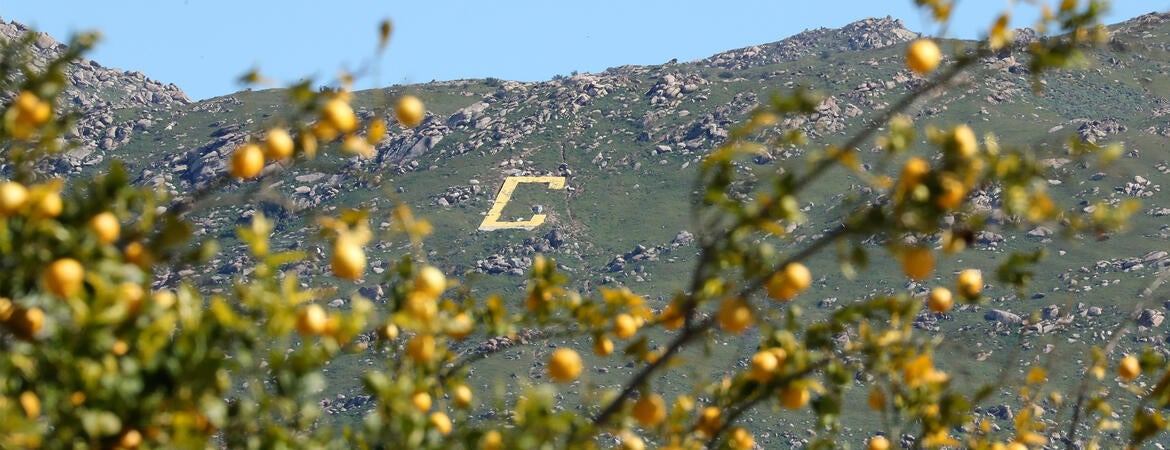
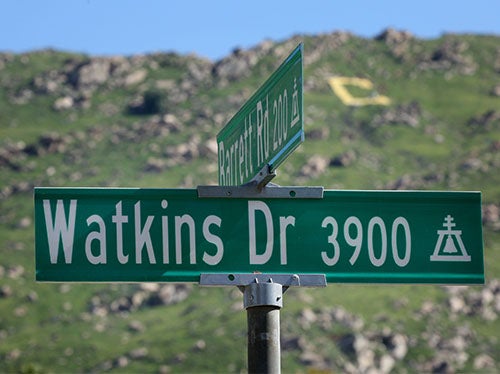
In 1955, UC Riverside students constructed a “C” on Box Springs Mountain, sitting approximately 1,500 feet above the campus. At 50 feet wide and 123 feet tall, it’s the largest “C” in the UC system.
The history of the Big “C” dates to 1905 at UC Berkeley. After the founding of the University of California in 1868, students participated in class rush, an annual event where freshmen placed their class number on the hillside before Charter Day. When UC Berkeley deemed the activity unsafe, the freshmen and sophomore classes of 1907 and 1908 built a “C” on Charter Hill near campus and painted it gold.
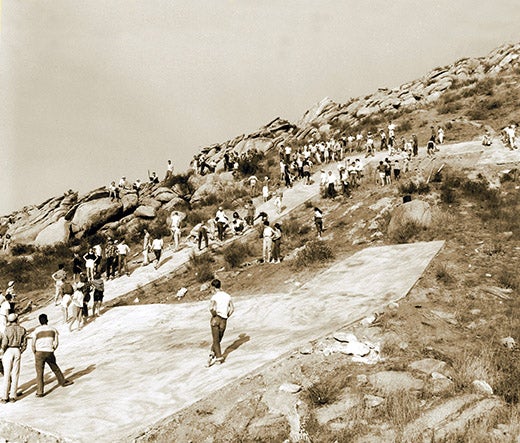
Fifty years later, students at UCR constructed their own “C,” asserting the letter stood for “Cal.” This decision sparked controversy among UC Berkeley students and alumni, who argued that because "Cal" originated from their campus — the first in the UC system — the nickname belonged to them.
Despite the conflict, UCR students moved forward with the Big “C.” They began the project by clearing a road to the top of the mountain and outlining the letter with chalk.
According to a 1956 issue of the UCR Highlander newspaper, the members of the Physics Club used walkie talkies and survey equipment between the mountains and Weber Hall to choose the location for the “C”. They initially used UC Berkeley’s dimensions — 26 feet wide and 60 feet tall — but enlarged it for better visibility.
Jack Yeager, a UC Berkeley alumnus and lifelong Riverside resident, made significant contributions to the project. E.L. Yeager Construction Co., founded by Yeager’s father in 1919, provided tractors, bulldozers, and cement mixers for the “C.” Students brought their own tools and supplies, making several trips up the mountain.
“They would bring a truck and load students into it,” said Ed Cowan, a 1958 Pioneer Class alumnus. “We loved it. It was great.”
Construction of the “C” was finished in 1956, and Yeager Construction Co. completed the final concrete pour in 1958.
Over the years, the Big “C” has become a symbol of campus pride. In the 1970s, UCR Student Life hosted Scot’s Week, a spirit week where student groups competed in various games, such as “Race to the C.” Students have also hiked to the “C” for good luck during finals week.
Andy Plumley, UCR alumnus and former associate vice chancellor of auxiliary services, has many memories from his time as a student and employee.
“To me, the Big C represents the spirit of students at UCR,” Plumley said. “This has held true throughout my 40-year career of working on campus, starting as a resident director and retiring as an associate vice chancellor.”
He recalls a year when Housing Services gathered new freshman students during the residence halls move-in week to paint the “C.” They started with 100 residents, but due to the summer heat and difficult climb, only about a dozen students made it to the top to paint it.
There have also been efforts to illuminate the “C” during Homecoming, with mixed results. A high-powered spotlight failed to cut through the evening mist, while solar landscape lights successfully lit the “C” until they were removed because of habitat restrictions.
The Big “C” has been the target of various campus pranks, including covering it with dirt to make it disappear or adding a plus or minus sign during finals week. Fraternities have added Greek letters to represent their organization, and students at Riverside City College even placed an “R” before the “C” for “Riverside College” as a playful joke.
“There are so many layers of paint on there, it’s practically a hazmat site,” Gurumantra Khalsa, a member of the University Neighborhood Association, said in the Press Enterprise during one of its disappearances.
In 2015, the Perris Valley railway line extension project began, aiming to expand the Metrolink’s commuter line. However, residents who hiked in the area voiced concerns that the project would obstruct the trail to the Big “C” and create additional hazards from the combination of quiet, high-speed trains and people crossing the railroad tracks.
The project was completed in 2016, with the “C” remaining accessible through alternate trails, but hikers are discouraged from crossing the tracks. Although the hike has its challenges, many still make the trek to see the "C” and enjoy the scenery.
“Nothing beats the view from the Big ‘C,’” Plumley said.
Seventy years after its construction, the Big “C” remains a symbol of UCR’s earliest years. As the university has expanded in size, reputation, and impact, the “C” is a lasting reminder of where the campus began and the future ahead.