
Researchers have identified a network of connections linking the brainstem and spinal cord that helps control hand and arm movements, revealing an unexpected layer of the nervous system enabling people to grasp, hold, and manipulate objects.
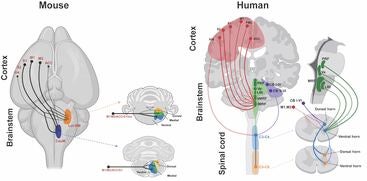
The UC Riverside-led research, published in the Proceedings of the National Academy of Sciences, shows that signals controlling voluntary hand movements travel not only directly from the brain to the spinal cord, but also through relay centers in the brainstem and topmost segment of the spinal cord. By mapping this pathway, researchers say the work could help guide new therapies aimed at restoring hand and arm function after stroke or other neurological injuries.
The brainstem is a narrow stalk of tissue at the base of the brain that connects the brain to the spinal cord and regulates many fundamental functions such as breathing, posture, and balance. The outer cortex, the brain’s large, wrinkled outer layer, is traditionally considered the command center for voluntary movement and conscious thought.
“For a long time, we thought fine hand movements in humans were controlled almost entirely by the cortex,” said Shahab Vahdat, an assistant professor of bioengineering at UCR, who led the study. “What we are observing is that evolutionarily older brainstem structures also play an important role.”
The researchers observed activity in two regions of the medulla, the lowest portion of the brainstem that sits just above the spinal cord and helps regulate essential processes such as breathing and heart rate. The medulla also acts as a major crossroads for signals traveling between the brain and body.
To investigate how these systems interact, the team used functional magnetic resonance imaging, or fMRI, to examine brain activity during controlled hand movements in both mice and humans.
In mice, animals were trained to press a small lever with their forepaw while researchers recorded activity in the brain and brainstem. Human volunteers performed a similar task in the scanner, squeezing a device with varying levels of force using their fingers.
“We wanted to see whether the same underlying network that controls forelimb movement in rodents might also exist in humans. It wasn’t a given, since humans have more advanced motor control,” Vahdat said. “Despite the differences between our brains, we found striking similarities in how these regions communicate.”
The scans revealed two regions of the medulla that were consistently active during the tasks and strongly connected with sensorimotor areas of the brain. The same regions appeared in both species, suggesting the underlying circuitry is conserved across mammals.
The study also shows for the first time, by measuring brain activity in humans, that two segments of the spinal cord in the neck, cervical levels C3 and C4, help control the hand by acting as a relay between the brainstem and the lower spinal cord that directly activates hand muscles.
Together, the findings suggest that voluntary hand movement relies on a multi-stage pathway in which signals from the cortex are integrated with brainstem and spinal networks before reaching the muscles.
The work may also have implications for stroke rehabilitation. Damage to cortical motor regions often leaves patients with lasting difficulty using their hands, and identifying additional movement pathways could provide new targets for neuromodulation therapies designed to stimulate surviving circuits.
“These pathways give us additional targets to explore,” Vahdat said. “If we can engage them after a stroke, they may help compensate and restore function in the hands and arms.”
(Cover image: Orla/iStock/Getty)