

Is the internet losing its soul? A collaborative study by UC Riverside computer and social scientists suggests so. As artificial intelligence increasingly answers our online questions with quick summaries and polished explanations, we may be gaining efficiency while losing something distinctly human in the process.

The study found that large language models, or LLMs, such as ChatGPT and Gemini overwhelmingly rely on logic and factual consistency when responding to subjective questions, while web pages written by humans draw from a richer mix of reasoning that includes emotion, lived experience, ethics, and personal authority.
“As people increasingly rely on AI systems for information discovery at the expense of traditional web searches, the web may gradually lose its soul and cease to reflect the human nature that has shaped it over the past 25 years,” said co-author Vagelis Hristidis, a computer scientist at UCR’s Bourns College of Engineering. “This may give rise to new information dissemination platforms in the future.”
Another co-author, Kevin Esterling, a professor of public policy and poltical science, added, “As humans, we’re hardwired to think that anything producing language has human cognition behind it, but this paper is showing that machines produce language that doesn’t have human qualities when it comes to reasoning and argumentation.”
The study compared how AI systems and traditional web searches respond to controversial or opinion-based questions, such as whether governments should ban fossil-fuel cars or whether the U.S. healthcare system needs major reform. It was presented this week at the ACM Web Science Conference in Braunschweig, Germany, by UCR computer science doctoral student and lead author Md Taukir Azam Chowdhury.
To conduct the study, the researchers analyzed responses from ChatGPT and Gemini alongside results from Google and Bing web searches. Using hundreds of subjective questions drawn from established research datasets, they examined not only the positions taken by the systems, but also the types of justifications used to support those positions.
The researchers classified reasoning according to Aristotle’s rhetorical triangle: logos, ethos, and pathos. Logos refers to logic and factual consistency. Ethos appeals to authority or credibility. Pathos appeals to emotions and shared human experience.
“What we found is that humans essentially use all three of those, whereas LLMs essentially only rely on logos,” Esterling said. “The way they try to persuade is different from the way humans persuade.”
Esterling said the difference becomes obvious in everyday searches.
Suppose someone wants a margarita recipe. An AI chatbot may instantly produce a competent recipe distilled from massive amounts of training data. But by bypassing culinary blogs and personal stories, users also miss the details that could make mixing and consuming the drink more memorable and rewarding.
The website Difford’s Guide, for example, offers dozens of margarita recipes divided into seven styles, including classic, fruity, floral, herbal, and spicy. Written by Simon Difford, the site also provides a history of the cocktail, tracing it back to a journalist’s discovery in the 1930s of a drink then called the “Tequila Daisy” during his travels in Mexico. (Margarita is the Spanish word for daisy.) He further documents with a 1936 newspaper report how it was created unwittingly by an Irish bartender in Tijuana who had grabbed the wrong bottle while trying to mix another drink.
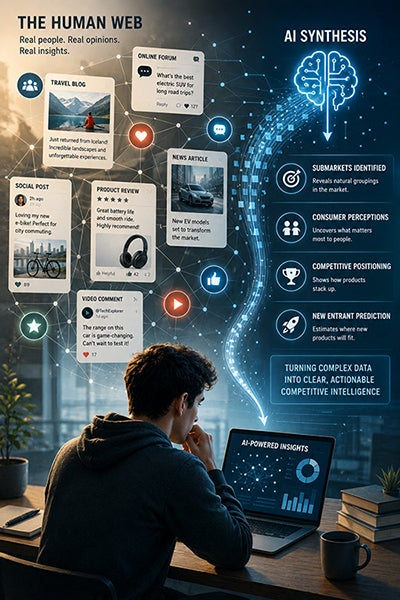
LLMs, however, filter out such depth, nuance, and passion that human writers bring to the table.
The study also found that web pages contain a far broader range of reasoning styles than LLMs. Human-authored web content mixed factual arguments with moral concerns, practical consequences, emotional appeals, and storytelling. For example, a call for funding food banks may draw on the writer’s experience with childhood poverty.
AI systems, by contrast, strongly favored fact-centered explanations that “prioritize logos-type reasoning,” Esterling said.
The researchers suspect this may stem partly from the “alignment” and safety systems AI companies build into their models. These guardrails are designed to steer responses toward factual, non-harmful answers and away from controversial or emotional language.
The study also found that ChatGPT and Gemini closely resembled each other in how they answered questions, even when their responses diverged significantly from the broader diversity found on the web.
Esterling said humans communicate very differently from machines because people constantly anticipate how others will react emotionally and intellectually during conversation.
“When humans talk to each other, we can understand what the other is thinking,” he said. “There’s this kind of two-way interaction.”
Large language models, however, do not truly think about the audience in that way, he said. Instead, they generate statistically probable sequences of words based on training data and internal parameters.
“It’s not like talking to a person at all,” Esterling said. “It’s just a machine that’s predicting what words ought to be said in response to a prompt.”
The researchers warn that as more people rely on AI systems instead of traditional web searches to understand politics, health, ethics, and public affairs, society could gradually lose exposure to the messy but deeply human diversity of reasoning that shapes public discourse.
The AI-based research may be faster and more efficient. Still, it is also flatter, less personal, and less connected to the emotional and moral experiences that help people understand one another, Esterling said.
Hristidis added, “When using AI platforms instead of Web searches, we retrieve a distilled version of knowledge, constrained by the guardrails of each AI platform, and missing any human emotion or opinion diversity.”
The study’s title is “Comparing the Subjective Opinions and Justifications of LLMs and Web Search Engines.” The research team included Esterling, Hristidis, Chowdhury, and doctoral students from the Computer Science and Engineering Department: Jannat Ara Meem, and Zabir Al Nazi. Chowdhury led the experiments for this work.