
A study co-led by a University of California, Riverside biomedical scientist has identified new targets for coronavirus antiviral drugs, including treatments that may be less vulnerable to the rapid evolution of these viruses.
The research, led by Joy Xiang at UC Riverside and Gene Yeo at UC San Diego, mapped previously unknown interactions across the SARS-CoV-2 genome between RNA and proteins involved in the virus’s replication and regulation. SARS-CoV-2 is the coronavirus that causes COVID-19. The team identified specific sites involving the RNA-dependent RNA polymerase (RdRp) and the nucleocapsid (N) protein and found that disrupting these interactions significantly reduced viral replication.
The findings, published in Nature Communications, offer an early proof of concept for targeting the virus at critical points in its life cycle rather than focusing on rapidly changing features such as the virus’s spike protein.
“SARS-CoV-2 evolves very quickly, so it’s important to understand the really basic and essential machinery of the virus,” said Xiang, an assistant professor of biomedical sciences in the UCR School of Medicine. “If we target something essential that the virus depends on to function and can’t easily change, the virus is less likely to evolve away from it, which would lead to drug resistance.”
Current antiviral drugs already illustrate the value of targeting essential viral machinery. Remdesivir targets RdRp, the enzyme that copies the virus’s RNA genome, while Paxlovid targets viral proteins involved in processing the long protein chains produced during infection.
Xiang and her collaborators used a technique known as enhanced cross-linking and immunoprecipitation, or eCLIP, to survey the viral genome and determine where viral proteins interact with RNA. Rather than examining only regions predicted in advance to be important, the approach allowed the researchers to map interactions across the genome and identify unexpected sites.
One finding involved the N protein and a region at the beginning of the viral genome known as the 5′ untranslated region. This region contains a complex RNA structure that is highly conserved among coronaviruses, but whose precise functions are not fully understood. The researchers found that its interaction with the N protein appears to regulate translation, the process by which viral RNA is used to make proteins.
The researchers also identified a previously unknown interaction involving RdRp and the RNA encoding viral protein NSP3. The finding suggests that viral RNA may play regulatory roles beyond simply serving as a template for producing proteins.
“Viruses look simpler than humans at first glance, but there’s a lot of underlying complexity to their molecular biology we’re only just beginning to unravel,” said Yeo a professor of cellular and molecular medicine at UC San Diego. “Our findings suggest that viral RNA may have a more significant role in regulating fundamental cellular processes than we previously understood.”
The researchers next tested whether the newly identified regions could be disrupted using antisense oligonucleotides — short, modified nucleic acid sequences designed to bind specific regions of RNA. Blocking the interaction sites significantly reduced viral replication in Vero cells, which are derived from African green monkey cells.
The team found similar results in human lung cells, providing additional evidence that the interactions could be relevant to human infection. Their findings suggest that targeting conserved viral processes can work across diverse cells, organs, and host organisms, which is a crucial factor in preparing for future zoonotic spillover events that lead to epidemics.
Xiang said the work is still at an early stage. The experiments were performed in cell cultures, and animal studies are needed to determine whether the findings could eventually translate into a therapeutic approach, she said.
The research also points toward the possibility of developing treatments that could work against multiple coronaviruses. Because some of the proteins and RNA sequences involved in these viral life cycle processes are conserved among coronaviruses, targeting them could be less dependent on the emergence of individual viral variants.
“The goal is to understand these core interactions so that, eventually, drug developers can develop therapies that specifically target them,” Xiang said.
The initial genome-wide interaction mapping was conducted at UC San Diego, where Xiang completed her postdoctoral research with Yeo. Xiang subsequently conducted the work at UCR after she joined the faculty in 2024, using startup funds, a UC Regents Faculty Fellowship, and a UCR School of Medicine Dean’s Collaborative Seed Grant.
Xiang is now independently pursuing research into similar RNA-protein interactions in other viruses, while Yeo’s group at UC San Diego continues developing RNA-protein interaction technologies.
For Xiang, the broader significance of the research extends beyond COVID-19 and the development of a single drug.
“We need to understand the fundamental biology of these viruses instead of just being reactive to outbreaks,” she said. “There’s value in studying these biological differences, because that understanding can give us new opportunities to develop better treatments.”
Xiang and Yeo were joined in the study by researchers at UCR and UC San Diego.
The title of the paper is “Genome-scale eCLIP mapping of SARS-CoV-2 RNA Interactions with NSP8, NSP12, and N Reveals Regulatory Sites.”
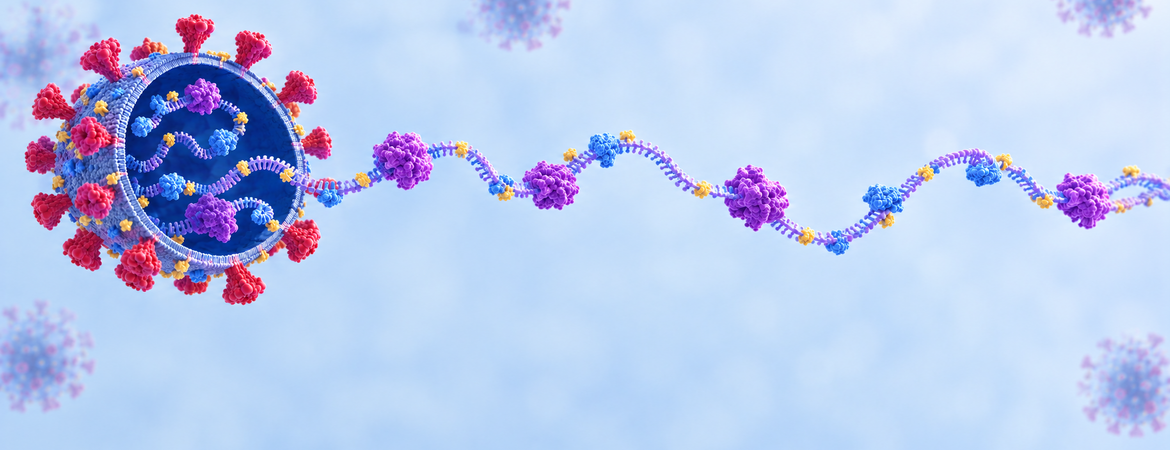
AI-generated header image maps the hidden RNA–protein landscape of SARS-CoV-2. A cutaway view of the virus reveals its RNA genome and associated viral proteins. We systematically mapped protein–RNA interactions across the SARS-CoV-2 genome to uncover previously unknown regulatory sites that contribute to viral replication. Large purple: RNA-dependent RNA polymerase (RdRp; NSP12); small yellow: NSP8 (polymerase cofactor/primase); blue: nucleocapsid (N) protein. (UCR/Xiang lab)