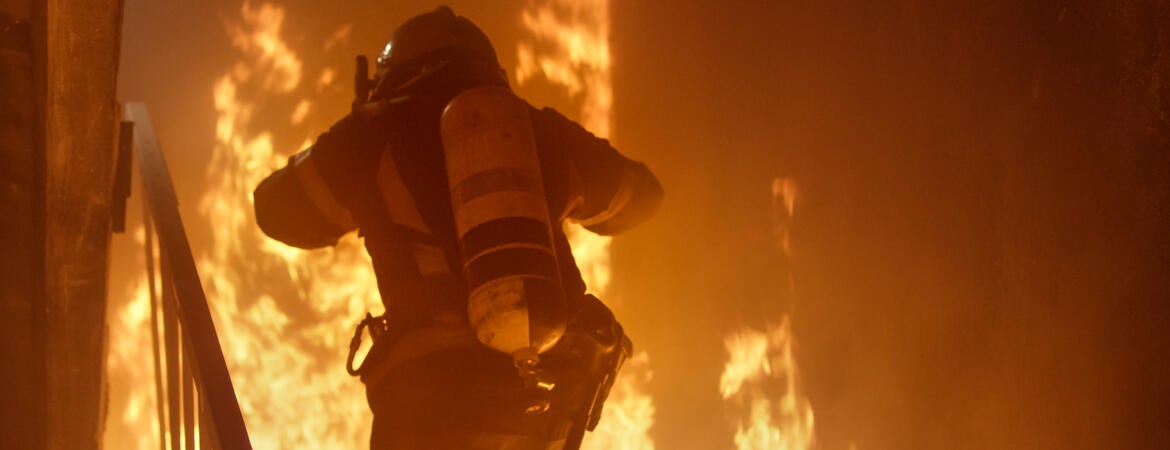

A soot-caked helmet and grimy turnout gear have long been symbols of grit and experience among American firefighters. Yet exposure to contaminated equipment can increase the risk of cancer.
Now, attitudes toward protective wear and other safety measures may be shifting in California firehouses.
A new study led by researchers at the University of California, Riverside examines how cancer-prevention practices are taking hold among firefighters in the state.
The findings were published online Aug. 4 in the journal Social Science & Medicine.
Based on 48 interviews with firefighters across Northern and Southern California, the researchers assert that durable change requires more than safety mandates and information. Instead, it requires a deeper shift in the values that confer status within firefighting.
In professions with strong occupational identities, the researchers argue, health information must compete with — and ultimately reshape — deeply held ideas about belonging and what it means to be good at a job.
Culture built on risk
Firefighting has long prized a masculine ethos of toughness and risk-taking, which can make health precautions look like weakness, the researchers say. Some firefighters once fought fires without wearing a self-contained breathing apparatus. This practice, known as “smoke eating,” was considered a sign of bravery rather than recklessness.

“That whole machismo and toxic masculinity idea lends itself to firefighters not wearing or using safety tools, because the general, though inaccurate, perception is that it makes you weaker,” one study participant is quoted as saying. “And that’s a big reason why a lot of people won’t use things that could mitigate long-term health issues.”
Another is quoted as saying that in the old fire station pecking order, “whoever got the dirtiest [turnout] was considered the coolest.”
“That symbolism has real consequences,” said Justin Huft, a doctoral student in sociology at UCR and the study’s first author. “Previous research has found that firefighters who viewed dirty gear as a badge of honor were more than twice as likely to engage in behaviors that increased their exposure to carcinogens.”
Despite years of public-health campaigns, medical screenings, and equipment upgrades, cancer remains the leading cause of occupational death among firefighters, the researchers note. Such approaches treat cancer prevention largely as a technical or educational problem — a matter of getting the right information to firefighters — rather than addressing professional identities and status symbols that shape behavior, the study says.
What works
The researchers identify three intertwined changes that help safety practices take hold in California firehouses.
First, whereas cancer prevention was once peripheral to what it meant to be a skilled firefighter, it’s increasingly treated as essential knowledge that’s core to the profession. Fire academies often incorporate cancer-prevention lessons into training for new recruits.

Second, prejudice toward clean gear is decreasing. What was once mocked as a sign of excessive caution is increasingly seen as a new professional standard. Still, the researchers did not find that firefighters were abandoning the values of toughness and public service; rather, they were redefining them. Clean gear and greater use of breathing apparatuses are increasingly seen as signs of professionalism and even altruism: A healthy firefighter, several interviewees noted, is one who can keep showing up for the public and fulfill family obligations.
Third, the tight-knit social dynamics of the fire station — once a force for preserving old habits — have been redirected to reinforce newer, safer ones. Interviewees describe how peers now needle each other about dirty gear rather than praising it. “If my turnout pants were dirty, my crew would probably make a comment,” one study participant is quoted as saying.
What was once teasing in service of bravado has become teasing in service of safety. Veteran firefighters sometimes take on a policing or mentoring role with younger colleagues. “If I see a young guy not wearing his mask, I’m gonna be like, ‘dude put your mask on you moron,’” another firefighter told the researchers.
Cultural, symbolic, and social capital
In evaluating their findings, the researchers integrate two theories. The first is called fundamental cause theory, which holds that social conditions affect health because they determine people’s access to flexible resources — including money, knowledge, power, and social connections — that help them avoid health risks and cope with illness. This theory was developed by Bruce Link, distinguished professor of public policy and sociology at UCR and a co-author of the study, in collaboration with Jo C. Phelan, professor emerita of sociomedical sciences at Columbia University.
The second is the late sociologist Pierre Bourdieu’s field theory, which describes how people compete and cooperate over resources, status, and influence within particular social arenas, or fields. In this theory, people’s positions within their fields are influenced by the forms of “capital” they possess: cultural capital, social capital, economic capital, and symbolic capital.
In the study, the researchers say that cultural capital (cultural knowledge), symbolic capital (symbolic prestige), and social capital (social networks) had to shift together for new safety practices to take hold in California firehouses.
When clean gear and breathing-apparatus use become signs of professionalism, firefighters are more likely to put flexible resources, such as cancer-prevention knowledge, into practice, the researchers argue. New knowledge about cancer risk alone isn’t sufficient, because old symbols of toughness can still override it. Nor is it enough to redefine clean gear without a professional culture that values the new knowledge and social networks that can spread and reinforce it.
The shift also appears generational, said Wei Zhao, professor of sociology at UCR and the study’s senior author.
“Young firefighters who were exposed to cancer-prevention training in fire academy curricula seem to adopt the new norms more readily than veterans,” he said. Several older firefighters described themselves as almost reborn into safer habits later in their careers after colleagues developed cancer, Zhao added.
The authors caution that adoption of safety measures varied across departments, generations and career stages, and that their findings, based on a relatively small interview sample, may not translate directly to fire departments elsewhere in the country.
But they also suggest that their findings could extend to other high-risk, male-dominated professions, including mining, policing, and the military, where cultures of toughness have been shown to discourage everything from using protective equipment to seeking mental health care.
The example of California firefighters indicates that this resistance can bend, but only when new habits come dressed in old values like pride, service, and belonging.
The study was supported by the California Firefighter Cancer Prevention and Research Program of the University of California Office of the President.
(Header image: Getty Images/gorodenkoff)