
UC Riverside environmental engineers have identified key chemical reactions that occur when ultraviolet light is used to destroy “forever chemical” pollutants in water, providing a roadmap for developing more effective cleanup technologies.
The discovery, published in the journal Nature Water, details the chemistry involved in using UV light to break down per- and polyfluoroalkyl substances, or PFAS, a large group of persistent pollutants commonly known as forever chemicals.
Importantly, the researchers identified reactions and by-products that form as treatment breaks the exceptionally strong carbon-fluorine bonds that make PFAS so difficult to destroy, said Jinyong Liu, a UCR associate professor of chemical and environmental engineering and corresponding author of the study.
“Knowing this degradation mechanism gives us a better understanding of how to optimize the conditions for PFAS destruction and achieve deeper degradation, and gives us a much better roadmap for improving the technology,” Liu said, who holds the university's Won and Insook Yoo Endowed Chair in Environmental Engineering.
The findings can help researchers determine which treatment technologies, combinations of technologies, and operating conditions favor more complete destruction of PFAS, he said.
The study also corrects degradation mechanisms reported in earlier scientific literature that were based largely on assumptions rather than experimental evidence, Liu said.
The findings also could eventually help chemists design safer fluorinated compounds that break down more readily after use.
“By knowing the degradation mechanisms, we can give the solid input to the fluorocarbon industry to tell them how to design compounds that can more easily be treated to protect the environment,” Liu said.
PFAS came into widespread use beginning in the 1940s because of their ability to resist heat, moisture, grease, and stains. They have been used in thousands of products, including nonstick cookware, grease-resistant food packaging, stain-resistant carpets, cleaning products, paints, varnishes and sealants, and fire suppressants.

Over decades, PFAS have entered groundwater and contaminated drinking water and food.
Exposure to certain PFAS has been associated with increased cholesterol, weakened immune response, liver effects, pregnancy complications, and increased risks of kidney and testicular cancers.
Because of such health concerns, the U.S. Environmental Protection Agency in 2024 established enforceable federal drinking-water limits for several PFAS for the first time. The agency has since reconsidered portions of those regulations while retaining the stringent 4-parts-per-trillion limits for two of the best-known compounds.
The chemistry uncovered by Liu’s team involves a complex sequence of reactions. Ultraviolet light and sulfite generate highly reactive electrons that attack PFAS molecules and begin breaking their carbon-fluorine bonds.
As those bonds break, fluorine atoms are stripped from the molecules and released into the water as fluoride ions. Hydroxyl radicals and hydroxide ions also help break carbon-carbon bonds, fragmenting the remaining molecular chains.
The resulting shorter-chain compounds can undergo further defluorination, progressively dismantling the PFAS molecules and releasing more fluoride.
The researchers also found that formate — a simple compound containing carbon, hydrogen and oxygen — is the primary carbon-containing product produced during an important PFAS chain-shortening pathway. Earlier studies had proposed carbon dioxide, carbon monoxide or other products.
The released fluorine becomes fluoride ions in the water, a far less problematic form commonly found in drinking water to promote dental health.
Earlier research largely focused on hydrated electrons as the critical agents responsible for PFAS destruction. The UCR study found the chemistry is more complicated. Hydrated electrons, hydroxyl radicals, and hydroxide ions can all play important roles in reactions that break PFAS molecules apart and strip away fluorine.
The findings give engineers a more accurate understanding of the chemistry needed to improve treatment systems, Liu said.
The work builds on years of PFAS research in Liu’s laboratory. Lead author Jinyu Gao began investigating the mechanisms in 2022, initially as a UCR doctoral student and later as a postdoctoral researcher.
The team combined kinetic studies with extensive analysis of transformation products — compounds created as PFAS molecules break apart — to reconstruct chemical reactions occurring at different stages of degradation. This allowed the researchers to identify previously unrecognized pathways and determine the roles of hydrated electrons, hydroxyl radicals, and hydroxide ions in breaking carbon-fluorine and carbon-carbon bonds.
The paper, “Comprehensive Mechanisms and Pathways for PFAS Degradation Under UV Irradiation,” was authored by Jinyu Gao, Dandan Rao, and Jinyong Liu of UC Riverside’s Department of Chemical and Environmental Engineering.
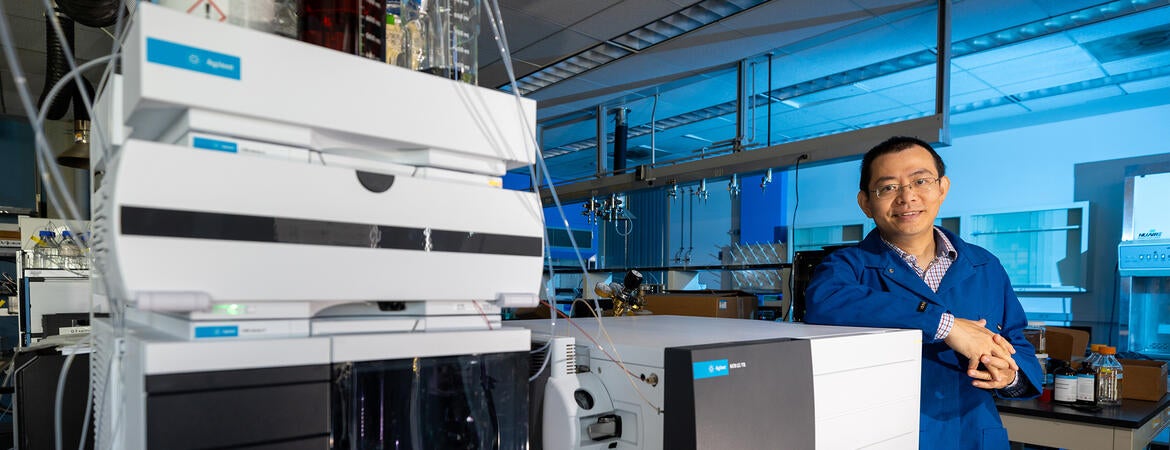
Header image: Jinyong Liu with a mass spectrometer he uses as part of his PFAS research (Stan Lim/UCR)