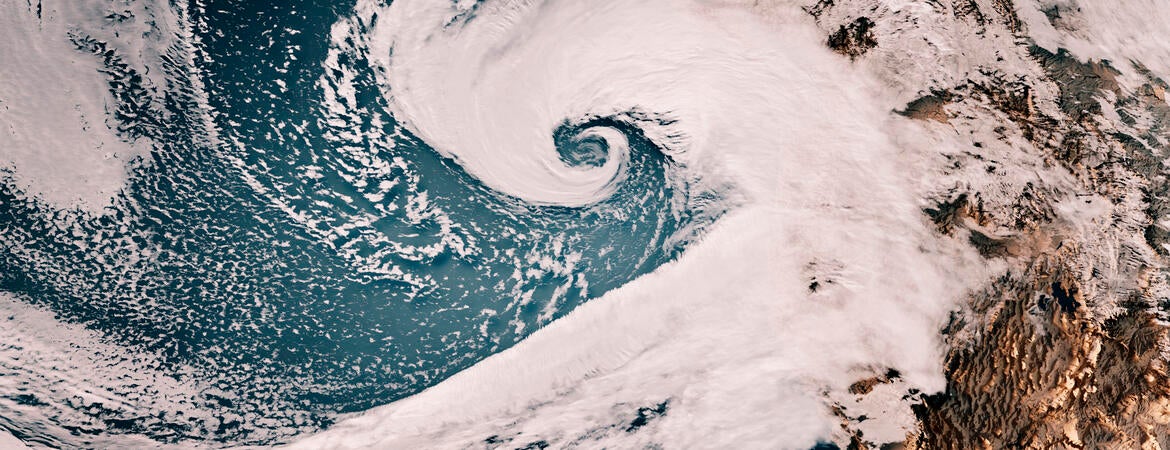

A slowing Atlantic Ocean current is projected to intensify powerful storms in California while reducing snowfall over Greenland, according to a new University of California, Riverside study.
The Atlantic Meridional Overturning Circulation, or AMOC, works like a giant conveyor belt in the ocean, moving warm water from the tropics northward to heat places like Europe, then cycling the cooled, denser water back south along the ocean floor.
“It is well known that the AMOC is a big player in the world’s climate system, and that it is slowing down. What we didn’t know is exactly how the AMOC might impact atmospheric moisture and storms outside the Atlantic region,” said Mohima Mimi, a UCR doctoral student in climate dynamics and the paper’s lead author.
“It turns out a weakening AMOC will strengthen storms across parts of North America by the end of the century, along the California coast in particular, while reducing them over Greenland and the Arctic.”
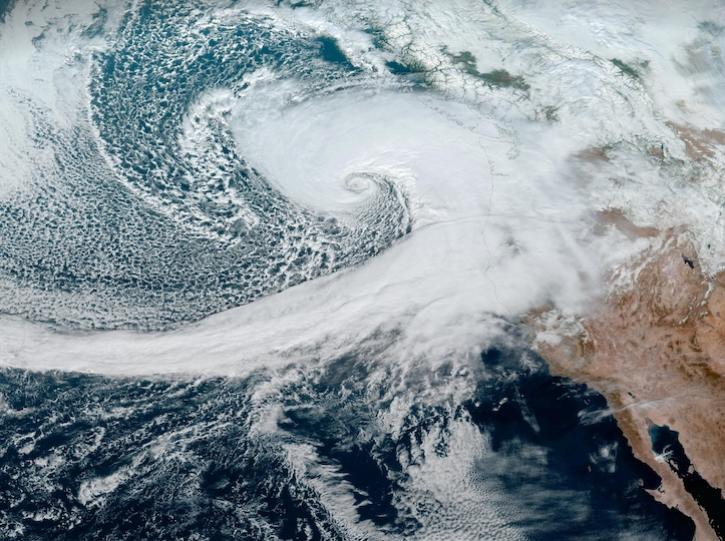
The study in Nature Communications found that as the AMOC slows, changes in ocean temperatures affect the amount of moisture the atmosphere can hold and strengthen high-altitude winds that steer storms across the Northern Hemisphere. Stronger winds allow storms to transport more moisture toward the West Coast, creating atmospheric rivers.
These rivers are long, narrow corridors of water vapor carrying moisture from the tropics to higher latitudes. “In California, atmospheric rivers are a double-edged sword,” Mimi said. “They supply much of the state’s water supply, but as they become stronger, they’re likely to also bring widespread destruction.”
The modeling study also projects an increase in atmospheric rivers along the eastern coast of South America and around Antarctica, while showing that fewer storms in Greenland will reduce snowfall and the accumulation of ice there.
The changes projected by the study occur under a high greenhouse gas emissions scenario in which the AMOC continues to weaken throughout the century. Scientists have observed that the AMOC is slowing as human-caused climate change warms the planet, and climate models project that trend will continue if greenhouse gas emissions remain high.
Greenhouse gasses are primarily produced by burning fossil fuels such as coal, oil, and natural gas, as well as methane from livestock such as cattle, deforestation, industrial processes, and waste, including landfills. According to Wei Liu, associate professor of climate change and the paper’s senior author, reducing emissions from these sources can lessen the impacts on the AMOC and its intensifying influence on rainfall.
Although stronger atmospheric rivers increase flood risk and damage to infrastructure, they could also create opportunities to capture more water if communities expand storage capacity and improve forecasting.
The findings underscore how closely connected Earth’s climate system is. A change in a single ocean current can reshape rainfall patterns and extreme weather thousands of miles away, influencing water resources, ecosystems, and communities across multiple continents.
“This research shows that the effects of the AMOC extend far beyond the Atlantic Ocean,” Mimi said. “Understanding these connections will help us better prepare for future changes in water resources and extreme weather.”
(Atmospheric river cover image: FrankRamspott/NASA/NOAA)