

A nationwide analysis led by a UC Riverside professor provides one of the clearest pictures yet of where mothers are least likely to begin breastfeeding their babies in the United States and what circumstances associate with lower rates.
Published July 15 in the journal “PLOS Global Public Health,” the study suggests locally tailored infant health strategies may be more effective than a one-size-fits-all national effort.
Led by UCR public policy professor Tony Grubesic, the research found that race, education, and whether people live in urban or rural communities consistently influence breastfeeding initiation rates across the United States, but local conditions also matter.
In many counties, factors such as disability rates, the number of female-headed households, and women’s participation in the workforce played an important role, creating distinct geographic pockets where breastfeeding initiation rates differed from surrounding areas.
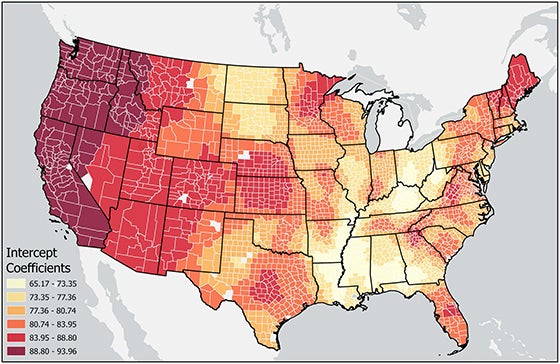
The study’s mapping of these local patterns could help guide public health officials as they allocate limited resources. The researchers identified many communities across Appalachia and the Gulf Coast as priorities for additional support, while counties in California, the Pacific Northwest, and the Northeast generally reported higher breastfeeding initiation rates.
Breastfeeding initiation refers to whether a newborn receives breast milk before leaving the birth facility. Health experts say breastfeeding effectively improves infant health because it is associated with lower infant mortality and reduced risks of sudden infant death syndrome, obesity, Type 2 diabetes, and other health problems. Mothers also benefit from reduced risks of breast and ovarian cancers.
The study recommends cost-effective strategies for improving breastfeeding initiation, including more access to lactation consultants in hospitals, encouraging breastfeeding support groups such as the La Leche League, and expanding eligibility for a federal nutrition program for women, infants, and children, known as WIC, by removing income restrictions for mothers seeking breastfeeding support.
Although national breastfeeding rates have improved in recent years, Grubesic said national averages conceal important local differences that can hinder effective public health planning.

“By providing a comprehensive county-level analysis, this manuscript deepens our understanding of the structural and geographic barriers to breastfeeding initiation, which remains one of the most effective preventive health measures for reducing infant mortality and protecting mothers against chronic diseases,” Grubesic said.
“Furthermore, the study demonstrates that applying advanced spatial statistical modeling significantly outperforms traditional statistical methods, offering public health officials a precise, data-driven roadmap for deploying cost-effective community interventions where they are needed most.”
The study analyzed breastfeeding initiation data for infants born in 2018 and 2019 in approximately 95.8% of U.S. counties. Researchers combined CDC data with California newborn screening data and examined how breastfeeding initiation related to a range of demographic and socioeconomic characteristics.
The researchers found that breastfeeding initiation rates varied dramatically between counties, ranging from about 22% to more than 90% nationwide. Rather than treating those differences as random, the researchers used advanced geographic modeling to identify local social and demographic factors associated with lower rates and pinpoint communities where targeted interventions could have the greatest impact.
Instead of relying on conventional statistical methods that assume the same factors influence every community equally, the team used multiscale geographically weighted regression, or MGWR, a geographic modeling technique that allows relationships to vary from place to place.

The findings confirmed broad regional patterns. Counties in the Northeast and along the West Coast generally had higher breastfeeding initiation rates, while lower rates clustered across portions of the Gulf Coast and Appalachia. The study also found important local differences. For example, counties with larger Hispanic populations showed stronger positive associations with breastfeeding initiation in the eastern United States but not in the West and Southwest.
Another notable finding involved female-headed households. The relationship between female-headed households and breastfeeding initiation was highly localized. Lower rates were observed in female-headed households across portions of the Upper Midwest, the Mississippi Delta, Appalachia, and eastern North Carolina.
The study’s title is “Spatial inequalities in breastfeeding initiation in the United States: A multiscale analysis of county-level determinants.” In addition to Grubesic, the co-authors are Wei Kang and Edward Helderop of UCR School of Public Policy; and Kelly M. Durbin of Childbirth International, Auckland, New Zealand.