
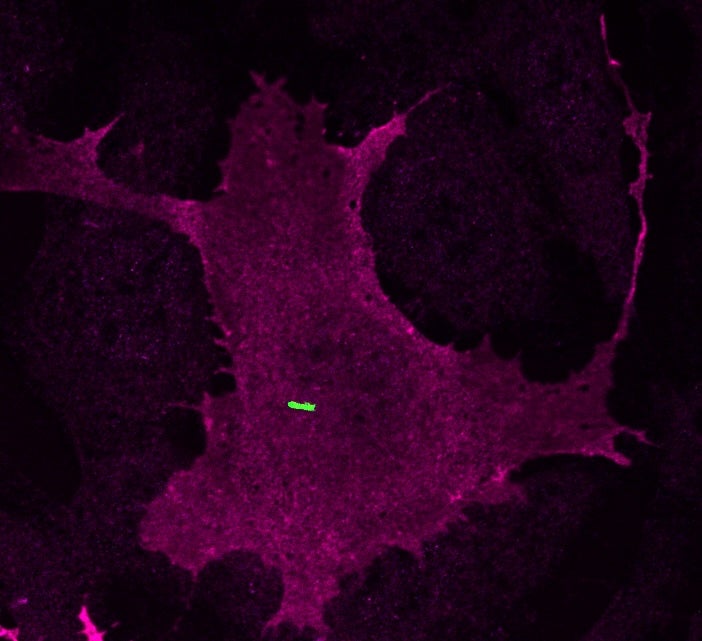
Cilia are tiny, hair-like structures that extend from the surface of many cells. The primary cilium, found on most cells in the body, acts much like a cellular antenna, sensing signals and environmental cues outside the cell and helping the cell respond.

Xuecai Ge, an associate professor of biomedical sciences at the UC Riverside School of Medicine, has received a $2.1 million grant, from the National Institutes of Health, to investigate previously unknown functions of the primary cilium. The five-year Maximizing Investigators’ Research Award will support her research project, “Integration of Cell Signaling by the Primary Cilium.”
“Even though nearly every cell in the body has a primary cilium, we are only just beginning to understand what it actually does,” Ge said. “Our research will reveal entirely new jobs for this cellular structure.”
The project builds on Ge’s recent work mapping the protein makeup of primary cilia. The new research will pursue two major directions. First, the team will investigate the protein-synthesis machinery inside primary cilia and determine whether proteins are produced locally within the organelle. Ge’s lab will pay particular attention to cilia in neural progenitor cells during embryonic brain development.
Second, the researchers will examine proteins found inside primary cilia that are associated with energy production.
“The cilium may do more than receive signals; it may also help regulate how a cell produces energy in response to its surroundings,” Ge said.
The research is now possible, she said, because technological advances have made it easier to study the exceptionally small organelle. A primary cilium accounts for only about 1/10,000 of a cell’s total volume. The team will use state-of-the-art technology and imaging techniques to examine protein synthesis and energy production at the subcellular level.
“Studying an organelle as tiny as the primary cilium requires high-cost technologies,” Ge said. “This grant provides the critical resources we need to scale up our recent discoveries.”
The project will use mouse models to study embryonic brain development, helping connect fundamental cell biology with neurological disease. The grant will support one postdoctoral researcher and one graduate student.
“Several of the proteins we are investigating are associated with neurodevelopmental and neurological disorders,” Ge said. “Our research could reveal new mechanisms underlying genetic diseases.”
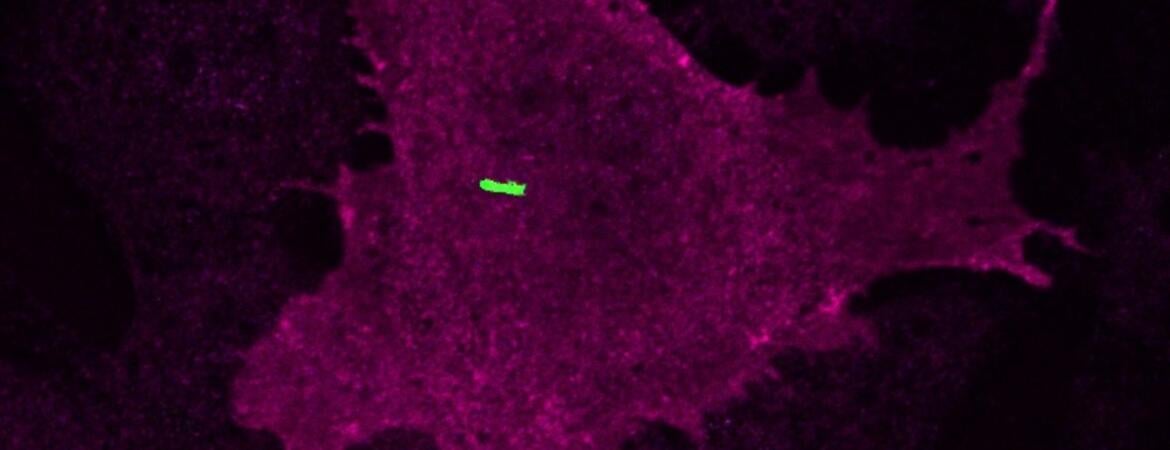
Header image shows a cell (purple) with its celium (green). Credit: Ge lab, UC Riverside.