
The Tuesday, Nov. 3 mid-term election was historic in many ways.
Michigan elected the first Muslim U.S. senator. Chris Pappas of New Hampshire will become the first openly gay U.S. Senator. Georgia elected its first female governor, and the first-ever Black female governor in the U.S. Florida elected its first Black governor. California and Texas elected their first Latino governors. Kansas elected its first Democratic senator in nearly 100 years. This became only the sixth out of 42 midterms since the 1860s in which a sitting president lost control of both houses of Congress.
Those who follow the polls closely may point to another milestone: National polls predicted a blue wave for Democrats, and the polls were correct this time. We discussed the polls with polling expert Andy Crosby, the potential for election challenges with political scientist Shaun Bowler, and Ukraine implications with Ukraine-Russia expert Paul D’Anieri.
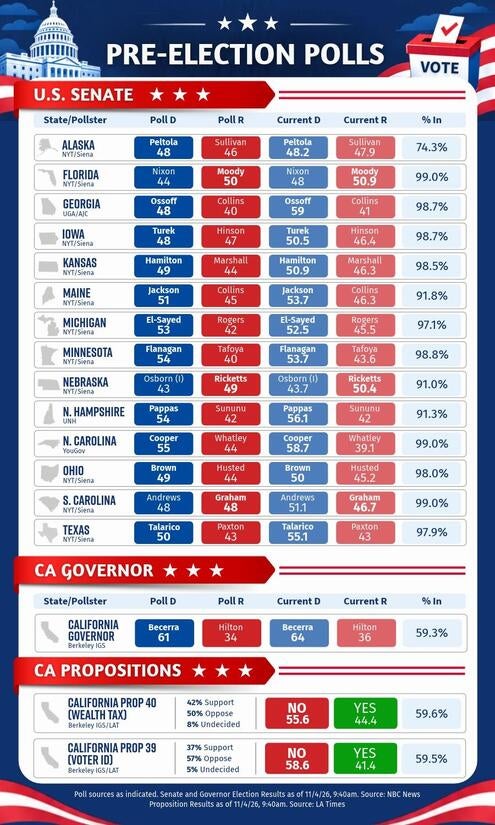
Q: As discussed in your recent Q&A, polls have undercounted Republicans in the 2016 and 2024 elections. Assess the polls’ performance in the Nov. 3 midterm elections.
Crosby: Overall, the polls performed extremely well this year.
Polls across both U.S. Senate battlegrounds and the California governor's race were consistently accurate. In the U.S. Senate, the leading candidate in every single final pre-election poll listed is consistent with current election results. Where polls did deviate, those deviations were largely expected. For example, one of the more recent Senate polls from Georgia was conducted October 7-15, weeks before the election. As such, we should not be surprised that undecided voters eventually made up their mind prior to the election.
Overall, though, a very solid year for trusted polls.
Q: In his initial reactions, Alaska aside, Trump's election interference rhetoric has been largely muted. Is it now safe to exhale and believe the new Congress will be seated without incident?
Bowler: The scale of the electoral wave is so big that this is probably too big to unsettle.
Q: Democrats made huge gains in deep red states. What do Dems need to do to make those inroads stick?
Bowler: One thing may be to work on trying to do away with gerrymandering. Voters don’t like gerrymandering. Putting in place laws that ban it/make it much harder to do for partisan purposes is probably the best thing the Democrats can do. A very, very bad second choice is to engage in it themselves.
Q: With a Democratic Congress, may Trump modify his approach to the Ukraine-Russia conflict?
D’Anieri: The honest answer is we just don’t know. One can imagine Trump doubling down on his intention to force Ukraine to capitulate. This would allow him to claim to have brought peace and would likely lead to some very lucrative business deals for Trump and his associates. One can also imagine that, having been rebuked in this election, he’ll change course.
With Trump now a lame duck, and with less apparent sway over voters, the “security Republicans” may team with Democrats in Congress to push for more aid to Ukraine. But they could find it difficult to change the administration’s policy.
Overall, what remains constant is Trump’s unpredictability.
Header image by Getty Images