
For decades, the Clean Air Act has resulted in clearer skies and better public health across America.
While the success of the law is—quite literally—invisible, it’s built on layers of regulations and policies informed by air pollution models that translate complex data into actionable intelligence. At the core of those models are simulations developed over the career of UC Riverside alumnus and research chemist William Carter.
Although Carter retired from his full-time faculty position in 2005, he has continued his work as an emeritus faculty member driven by a pressing concern—who will carry this work forward?
The answer comes in the form of Carter’s $2.2 million blended gift to UCR to establish an Atmospheric Chemical Mechanism Research Fund. The fund, a combination of a pledge and a planned gift, is already active thanks to an initial $200,000 commitment from Carter.
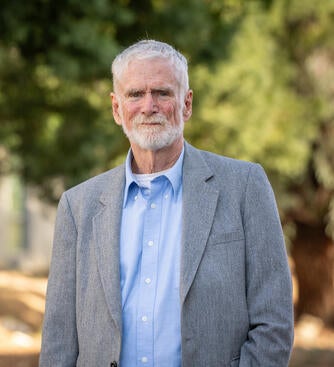
The gift is one of two Carter has recently made to UCR. In June he created an endowed scholarship fund with a pledge of $500,000 to honor his late friend and fellow alumnus Michael McCall. He has since pledged an additional $950,000 to this fund.
The McCall Student Success Scholarship Fund provides three years of funding to students who have successfully completed UCR’s Highlander Early Start Academy (HESA). In total, Carter has pledged an estimated $3.65 million to UCR.
“Dr. Carter’s gifts reflect his longstanding commitment to UCR’s mission of education, research, and public service,” said UCR Chancellor S. Jack Hu. “His atmospheric chemistry research has significantly advanced our understanding of pollutant behavior and contributed to improved air quality worldwide. As an emeritus faculty member, his continued support through this significant gift strengthens UCR’s capacity to advance this important area of research at a time when sustained investment is essential.”
Carter was born in Oregon but moved with his family to Eureka, Calif., where he completed elementary and junior high school before attending the private Lakeside School in Seattle. His college application to UC Berkeley resulted in an offer to a sister UC campus—UCR, then a fledgling university with about 5,000 students.
“I decided after attending UC Riverside that it was preferable to Berkeley because the campus was fairly small and had a nice feel,” said Carter, who enrolled as a chemistry major in 1963.
Within that close-knit environment, Carter’s talent stood out and a faculty member offered him an undergraduate research opportunity in gas phase kinetics—the study of how gases behave and react. With much of the work being in the laboratory, Carter even mastered scientific glass blowing to build the leak-proof, pressure-resistant systems used in his experiments.
After graduating with a bachelor’s degree in 1967, Carter started a doctoral program at Cal Tech. However, in a blip uncharacteristic of Carter’s career trajectory, he dropped out without completing the program.
“I sort of burned out and lived with my brother on his boat in Newport Harbor,” Carter said.
Carter lived on Orange County’s coast for about a year, he said, until his mother stepped in. While serving on the faculty of the writers’ workshop at the University of Iowa, she made inquiries that helped him secure a spot in graduate school there. This time he stuck with it, earning his doctorate in physical chemistry.
As a newly minted Ph.D., Carter turned his attention back to UCR, remembering research by Professor James Pitts, director of the Statewide Air Pollution Research Center (SAPRC), in the emerging field of air pollution. The work sounded meaningful, and Carter jumped at the chance to join the center as a postdoctoral researcher. That position eventually turned into a permanent research appointment and Carter has been on the UCR research faculty ever since.
Dramatic improvements in air quality
When Carter returned to Riverside in 1973, thick smog blanketed the Los Angeles Basin. Researchers at SAPRC and other institutions set out to uncover its causes, tracking how pollutants formed, lingered, and affected public health.
But unraveling the chemistry behind atmospheric processes is no simple task. A single compound released into the air can spark thousands of reactions and hundreds of products. To study these, scientists begin with a self-contained vessel known as a smog chamber.
“Into the smog chamber you inject the primary pollutants, turn on a UV light to mimic sunlight, and collect data on how quickly the pollutants disappear and what secondary pollutants form,” Carter explained.
After copious testing under various conditions, researchers can build a set of equations known as a chemical mechanism—a mathematical recipe describing what’s happening to the chemicals in our atmosphere.
“The detailed mechanism has everything but the kitchen sink … and sometimes it has the kitchen sink too,” Carter said. “From that, we develop a reduced mechanism that’s more efficient and requires far less computing power—ideally it tells you what you need to know and nothing more.”
That streamlined mechanism, paired with meteorological and geographic data, informs the air-quality models used by regulatory agencies in policymaking decisions and by companies developing cleaner products.
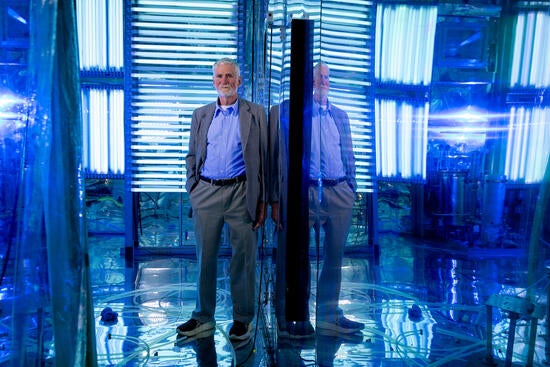
Early in his SAPRC career, Carter developed the first efficient chemical mechanism to describe the reactivity of more than 100 pollutants involved in ozone formation. First published in 1990, the SAPRC Mechanism—as it became known—was updated in 1999, 2007, 2016, and 2022, and has contributed to dramatic improvements in air quality in the U.S. and around the world.
A reactivity scale he published in 1994 provided a standardized way to compare the ozone-forming potential of conventional gasoline and alternative fuels, complementing efforts by automakers and oil companies pursuing greener technologies.
When UC Riverside founded the Center for Environmental Research and Technology (CE-CERT) in 1992, founding director Professor Joseph Norbeck invited Carter to join the center’s Atmospheric Processes Laboratory. Carter later moved to CE-CERT full time, where he led the design of the center’s indoor atmospheric chamber—the largest and most advanced facility of its kind in the world.
Over the course of his 50-year career, Carter has published hundreds of peer-reviewed journal articles and technical reports. Several papers have earned him recognition on Clarivate’s Highly Cited Researcher list, recognizing his enduring influence in their field of atmospheric chemistry.
Carter officially retired in 2005 at age 60. As an emeritus faculty, he has continued his work on chemical mechanisms.
While ozone is now less of a concern in the U.S., Carter said his mechanisms have applications in the study of other atmospheric processes, including the growing challenges of particulate matter and aerosol pollution. His endowed gift will ensure this work continues at CE-CERT by supporting current and future researchers in the field.
“I’d like to see someone build on the work I’ve done,” Carter said. “There aren’t many young scientists focused on atmospheric chemical mechanism development, so this could help support a graduate student or postdoc with that interest.”
Carter’s second gift, the McCall Student Success Scholarship Fund, honors his longtime friend’s wish to support students who are even earlier in their academic journeys.
The fund provides three years of support for undergraduate students who have successfully completed the year-long scholarship requirements for UCR’s Highlander Early Start Academy (HESA) —an intensive seven-week program that helps incoming first-year students build confidence and academic momentum. The first cohort of six students were awarded scholarships in November.
Both gifts, Carter said, are meant to make a focused difference.
“If I were a billionaire, I might try to cure diseases or end world hunger,” he said. “But since I’m not, I’d rather make a big difference for a few people than a tiny difference for many.”