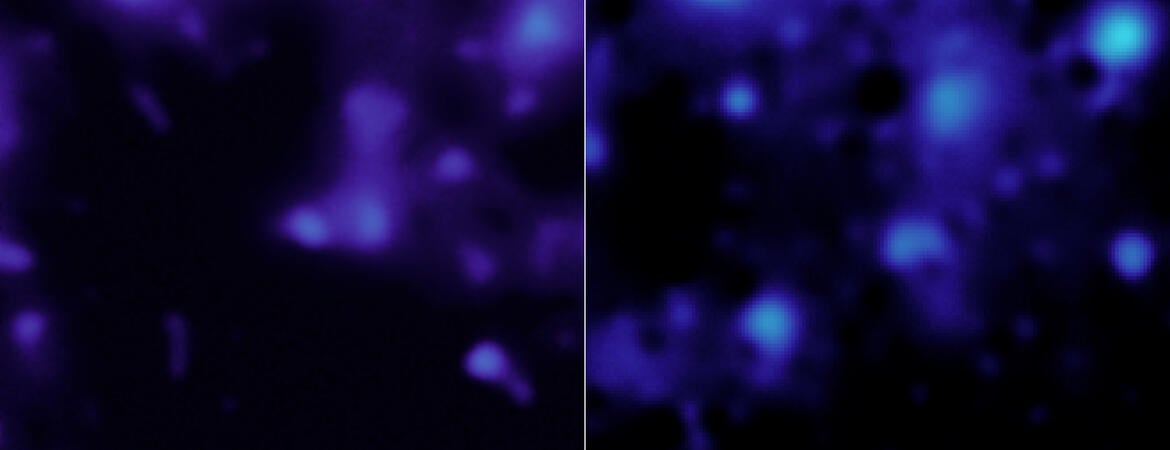
Using data from NASA’s James Webb Space Telescope (JWST), scientists, including astronomer Bahram Mobasher at UC Riverside, have made one of the most detailed, high-resolution maps of dark matter distribution ever produced. It shows how the invisible, ghostly material overlaps and intertwines with “regular” matter, the stuff that makes up stars, galaxies, and everything we can see.
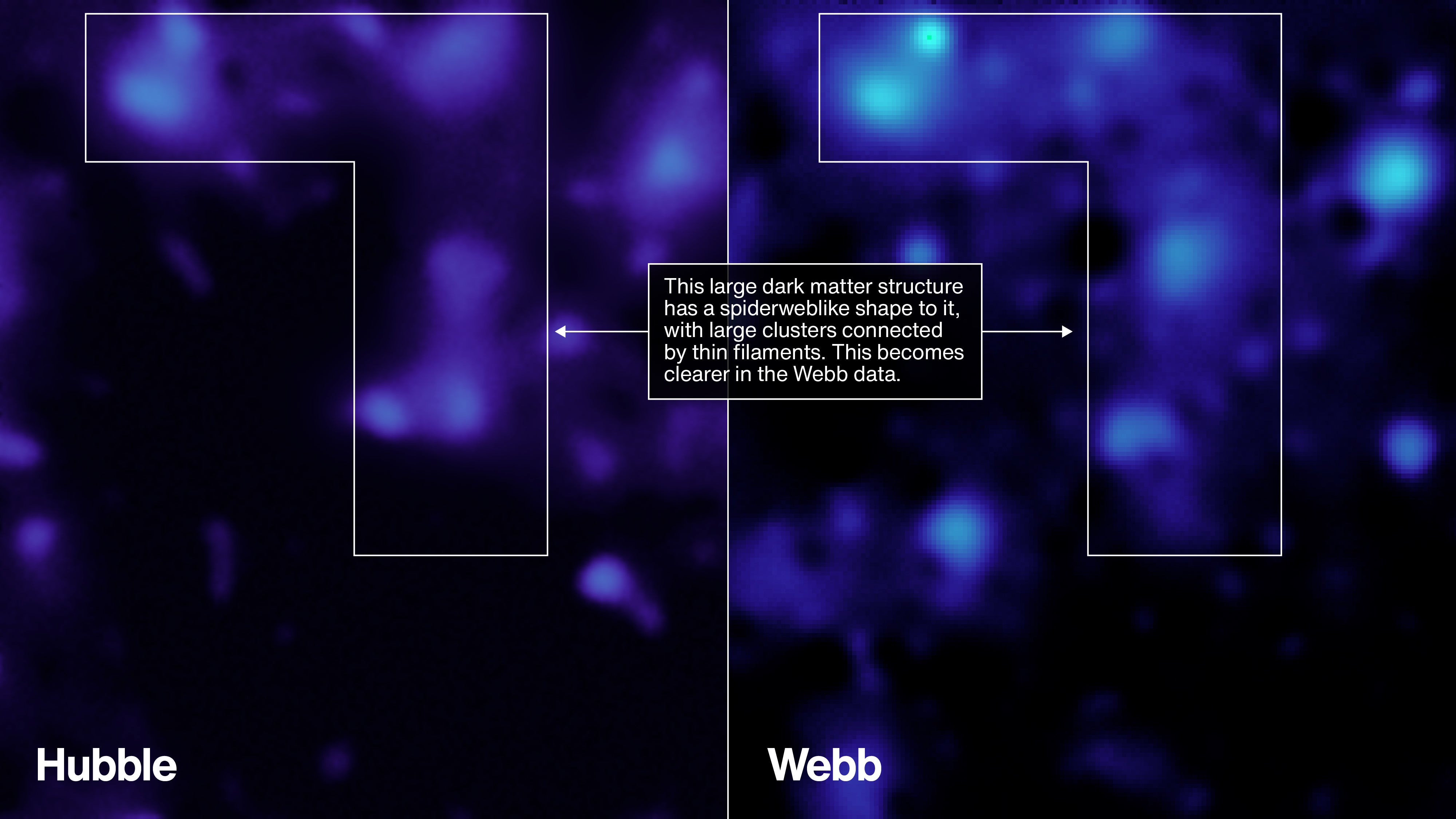
weblike structure known as the cosmic web. This pattern appears more clearly in the
Webb data than in the earlier Hubble image. Ordinary matter, including galaxies, tends
to trace this same underlying structure shaped by dark matter. (NASA/STScI/A. Pagan)
Published today in Nature Astronomy, the map builds on previous research to provide additional confirmation and new details about how dark matter has shaped the universe on the largest scales — keeping together galaxy clusters millions of light-years across or governing the formation of individual galaxies.
“This is the largest dark matter map we’ve made with Webb, and it’s twice as sharp as any dark matter map made by other observatories,” said Diana Scognamiglio, lead author of the paper and an astrophysicist at NASA’s Jet Propulsion Laboratory in Southern California. “Previously, we were looking at a blurry picture of dark matter. Now we’re seeing the invisible scaffolding of the universe in stunning detail, thanks to Webb’s incredible resolution.”
Dark matter doesn’t emit, reflect, absorb, or even block light, and it passes through regular matter like a ghost. But it does interact with the universe through gravity, something the map shows with a new level of clarity. Evidence for this interaction lies in the degree of overlap between dark matter and regular matter, with dark matter’s gravity pulling regular matter toward it throughout cosmic history. The map demonstrates that dark matter and ordinary matter always co-existed and evolved together during cosmic history.
A closer look
Found in the constellation Sextans, the area covered by the new map is a section of sky about 2.5 times larger than the full Moon. A global community of scientists has observed this region with at least 15 ground- and space-based telescopes for the Cosmic Evolution Survey (COSMOS). Their goal: to precisely measure the location of regular matter here and then compare it to the location of dark matter. The first dark matter map of the area was made in 2007 using data from NASA’s Hubble Space Telescope.
Mobasher, a distinguished professor of physics and astronomy at UC Riverside, is a founding member of the COSMOS project. The data he and his colleagues acquired helped build the 2007 dark matter map as well as the JWST dark matter map.
“The JWST dark matter map is deeper and has higher spatial resolution compared to the initial map we made using Hubble Space Telescope data,” Mobasher said.

With his students at UCR, Sina Taamoli and Hossein Hatamnia, Mobasher identified large scale structures — galaxy clusters, filaments, and groups — in the COSMOS field, which are expected to trace dark matter distribution and complement the current study by providing a distribution of the luminous matter that constitutes only 4% of the universe’s matter content.
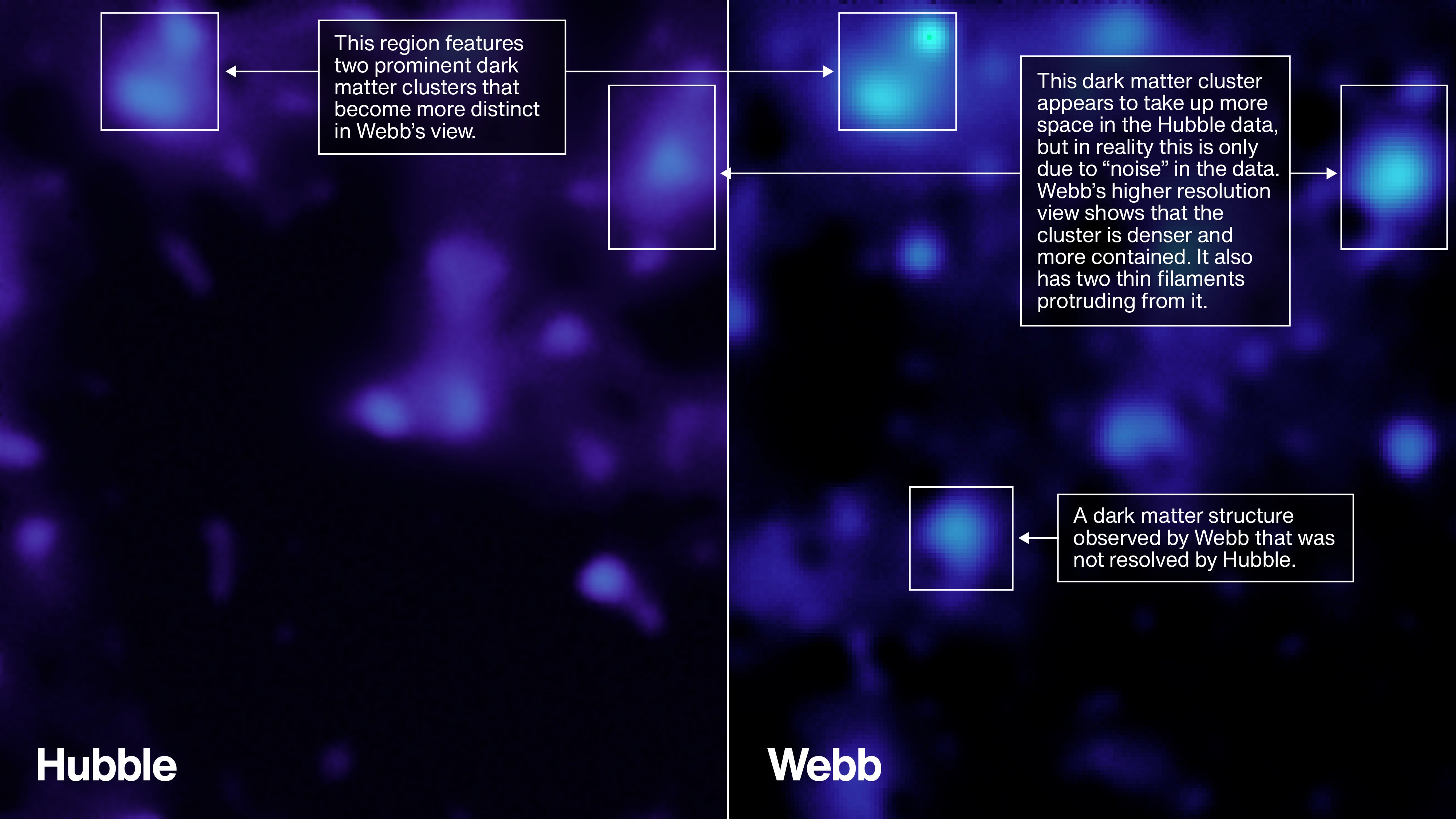
The Webb map contains about 10 times more galaxies than maps of the area made by ground-based observatories and twice as many as Hubble’s. It reveals new clumps of dark matter and captures a higher-resolution view of the areas previously seen by the Hubble Space Telescope.
Why it matters
When the universe began, regular matter and dark matter were probably sparsely distributed. Scientists think dark matter began to clump together first and these clumps then pulled together regular matter, creating regions with enough material for stars and galaxies to begin to form.
In this way, dark matter determined the large-scale distribution of galaxies in the universe. And by prompting galaxy and star formation to begin earlier than they would have otherwise, dark matter’s influence also played a role in the synthesis of the heavy elements responsible for the origin of life.
The authors plan to map dark matter with NASA’s upcoming Nancy Grace Roman Space Telescope over an area 4,400 times bigger than the COSMOS region. Roman’s primary science goals include learning more about dark matter’s fundamental properties and how they may or may not have changed over cosmic history. But Roman’s maps won’t beat Webb’s spatial resolution. More detailed looks at dark matter will be possible only with a next-generation telescope like the Habitable Worlds Observatory, NASA’s next astrophysics flagship concept.
This news release is a modified version of a Jet Propulsion Laboratory news release.
Header image: Created using data from NASA’s Webb telescope in 2026 (right) and from the Hubble Space Telescope in 2007 (left), these images show the presence of dark matter in the same region of sky. Webb’s higher resolution is providing new insights into how this invisible component influences the distribution of ordinary matter in the universe. (NASA/STScI/A. Pagan)