
What is the secret of happiness?
Sonja Lyubomirsky, a distinguished professor of psychology at UC Riverside, used to dread that question; she considered it reductive. As a leading expert on the science of happiness, however, it was an occupational hazard, and she would answer it by explaining that there are many determinants.
These days, Lyubomirsky has a more aphoristic, yet nonetheless truthful, response at the ready. It came to her after she struck up a conversation with Harry Reis, a professor of psychology at the University of Rochester, nearly a decade ago. She had known Reis, a preeminent expert on social interactions and relationships, for years, but this time told him about a television host who had pressed her about the secret of happiness.
Reis conceded that he didn’t have an answer, either, but had noted a key difference between happy and unhappy people: Happy people felt loved. The observation hit Lyubomirsky like a thunderbolt, resonating deeply with what she already understood about happiness from her own research.
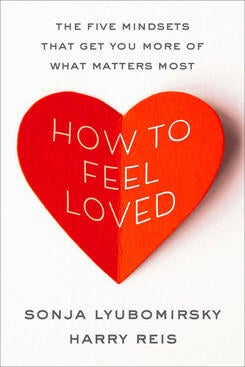
Lyubomirsky and Reis have since collaborated on a book, “How to Feel Loved,” that was published this month by Harper. Drawing on research and personal stories, the co-authors discuss five mindsets they assert can promote a sense of feeling loved, appreciated, and understood.
“To feel that the people in your life truly get you, value you, and love you is what makes life worth living,” they write. “This is what makes people happy.”
Lyubomirsky, who has been touring the country to publicize the book, recently made time to talk about its themes with UCR News. She addressed misconceptions about feeling loved and the rewards of fostering deep, honest connections with people. A fellow of the American Association for the Advancement of Science and of the Association for Psychological Science, Lyubomirsky is also the author of “The Myths of Happiness“ and “The How of Happiness.”
Q: You’ve spent decades pioneering experiments to test how people can become happier. What led you to focus on the feeling of being loved?
Lyubomirsky: It occurred to me after my conversation with Harry [Reis] that almost all practices that work to make people happier succeed because they make us feel more connected and more loved. So, that was a huge epiphany. If, for example, I write a letter of gratitude to my best friend, I feel more loved by my best friend. If I do a kindness for a neighbor or a colleague, I feel closer to them. I realized that to be a better happiness scientist, I had to become a love scientist.
Q: What would you say is the book’s main takeaway?
Lyubomirsky: One of the main theses is that to feel loved, you have to be known. You must be vulnerable, by which I mean willing to show more of your real self. Think about someone in your life whom you don’t feel loved by — or maybe not as loved by as you’d like to feel. Of course, this person may actually love you, but we’re talking about how you feel.
We all have positive and negative qualities, but if you’ve made a point of only showing this person your positive qualities — your “highlight reel” — you will always wonder, “Would they still love me if they knew the real me?” Truly being seen and heard is what creates that deep sense of security about feeling loved. It doesn’t mean you need to overshare or unload your burdens on someone in the first 10 minutes of meeting them; it’s about progressively revealing what really matters to you.
Q: But aren’t we sort of hardwired to want to show off our best attributes — to perform, in a sense? On a first date, for example, I somehow doubt people naturally will lean in to showing their full selves.
Lyubomirsky: Absolutely, and it’s not only a tendency on first dates. It may also happen when, for example, you meet a professional colleague for the first time. What happens on these first dates, in these first meetings, is we try to impress each other, right? That’s very human, and it’s also evolutionarily adaptive. We want to make a good impression. I want you to think that I’m interesting and smart and kind and funny and virtuous. Totally normal, totally human thing to do.
The problem is while I might succeed in impressing you, I’m not going to forge a connection with you. I’m not going to make either of us feel loved. Of course, that first date or first meeting might not be the time or place for making that kind of deep connection. You’re just starting your relationship. But if you really want to feel loved or meaningfully connected to a colleague, a neighbor, a partner, or a friend, you need to be vulnerable and ask those deeper questions.
Q: How do you achieve that kind of relationship with someone?
Lyubomirsky: The first step, counterintuitively, is to make the other person feel loved. And to do that, you need to show genuine curiosity about them. It’s so rare that people are really curious about you — like, how often does someone express curiosity about your inner life, about the details of your day? If I’m curious about you, that’s going to help you to open up to me.
I shouldn’t listen to what you tell me with the sole priority of formulating a response. I should really listen to you and be present with you. In the book, we call it listening-to-learn. That helps you feel safer and more trusting about revealing your real self.
Then, the idea is that you’ll reciprocate. Reciprocity is a very powerful norm — one of the most powerful, evolutionarily rooted social behaviors. Hopefully, you’ll show a real interest in me, too — in my inner life, feelings, and thoughts and ask me questions about them. You’ll listen-to-learn. So, it’s kind of this back and forth.
Q: Is this the process you call the “relationship sea-saw” in the book?
Lyubomirsky: Right. We use the metaphor of an underwater seesaw — hence the deliberate spelling of the word as “sea-saw.” Most of who we are is hidden beneath the surface, and we usually only show that highlight reel. When I show warmth, curiosity, and acceptance toward you, I help lift you up out of the water. As I listen carefully, you’re able to share more of your full self. Then, the idea is that you will reciprocate, showing interest in my inner life and helping to lift me out of the water in return.
Q: Many people equate happiness with external factors like success, wealth, or status. Why is feeling loved a more powerful driver of happiness than those things?
Lyubomirsky: We talk about this in the book. People think that they’ll be happy when they make more money, when they’re more attractive, when they have more power, status, more fame. Those are called extrinsic goals. But there’s decades of research showing that pursuing those things doesn’t make us happy.
Q: Do people actually want to be asked deep, personal questions? Or can it come across as prying?
Lyubomirsky: Research shows we often avoid asking people personal questions because we think it will be awkward or nosy. But more often than not, the other person craves being seen and known. We simply don’t ask each other enough real questions about our lives. Opening up that door is one of the most powerful things you can do to change a relationship.
Q: How has social media affected our ability to feel loved?
Lyubomirsky: Social media can amplify the feeling of not being loved because people mostly post the positive things. Everyone else looks happy, beautiful, and constantly on vacation. That comparison makes us feel worse. It reinforces the idea that we’re alone in our struggles, which is why showing more of our real selves can help us feel more human and more connected.
Q: Can you feel loved by an AI companion?
Lyubomirsky: Let me first say that I think people who are feeling very lonely can benefit from AI companionship. AI is the best listener you can have in the world. It will remember everything, so a human can’t beat it at that. It will also show curiosity in you. But one thing I really don’t believe is that it cares about your happiness, although you might be sort of deceived into thinking it does. It’s like when you see a movie. You may cry, laugh, or be scared. Yet you know it’s not real, even though it can summon powerful emotions.
Harry and I don’t think AI has all the features humans really need. Authenticity is the biggest one. There’s something deeply powerful about another person choosing to love you. That choice matters in ways that are hard to replicate artificially.
This interview has been edited and condensed.
(Header image: Getty Images/lechatnoir) | (Jacket design: Bonni Leon-Berman)