
As the leading figure of the 20th-century farmworkers’ movement, César Chávez is a staple of the K-12 curriculum in California. His work and activism are subjects typically taught to fourth-, ninth- and 11-grade students statewide, according to public school guidelines.
César Chávez Day, a state holiday observed March 31, also has been seen as an opportunity to teach about the iconic labor organizer.
That holiday was renamed Farmworkers Day shortly after The New York Times published an article on March 18 containing explosive allegations that the late United Farm Workers president had sexually abused and harassed women and girls.
The University of California system issued the following statement in response: “The University of California is aware of The New York Times investigation and is deeply concerned about these troubling reports. We stand firmly with survivors and are evaluating these findings internally. We will communicate updates when appropriate.” UC campuses, including UCR, are following system direction in reviewing how Chávez’s memory is represented on campuses.
For public school classrooms across the state, the challenge is profound: How to teach about Chávez in light of the allegations.
Miguel Zavala, an associate professor of teaching at UCR, has provided some thoughts on the matter in response to questions from UCR News. An expert on the growth and implementation of ethnic studies within the California public school system, Zavala is interested in the intersection of critical literacy, community organizing, and decolonial pedagogy.
How have the life and work of César Chávez traditionally been taught in public K-12 schools in California?
Traditionally, the approach to the representation of César Chávez within the K-12 curriculum falls under what scholar James Banks termed “heroes and holidays.” César Chávez thus appears as a Mexican American prominent figure, especially in relation to the migrant farmworker’s struggle for justice. While Dolores Huerta also appears in these narratives, the approach is a superficial one that doesn’t go beyond individual storylines. You might find picture books, for instance, in the elementary level. At the secondary level, what you typically see is Cesar Chavez as a labor leader that used non-violent tactics.
Going forward, what do you think would be the best approach for teaching about Chávez?
It’s interesting how the California Department of Education has issued a proviso on their website that provides some K-12 resources for teaching about César Chávez. On their website, they state: “The allegations of violence and abuse by César Chávez are deeply troubling and disturbing. In light of these revelations, the California Department of Education encourages all schools and educators to teach about the farmworkers’ movement as a struggle that is greater than one man.”
I would argue that it’s too easy to engage in the politics of erasure. What is challenging is to teach beyond heroes and holidays, to teach our students to think historically rather than about facts and figures throughout history. Thus, rather than focus on individuals, one might shift to collectives, such as migrant farmworkers. And from an ethnic studies pedagogical perspective, teaching about migrant farmworkers invites an opportunity to develop curricula that represent a “history from below,” or the “voice of the voiceless.” There are countless people making history, everyday people, whose stories are rendered invisible by focusing on individual leaders.
As well, it is vital to not just learn about migrant farmworkers but about the conditions — historical, economic, political, and ideological — that have shaped their lives in profound ways. This is then an opportunity to emphasize historical understanding. Of course, this means teaching about social movements and addressing contradictions within those movements. But to teach about migrant farmworkers and to think historically about the conditions impacting their lives, teachers need to also “study up” power.
In books published more than a decade ago, the journalist Miriam Pawel described some of Chávez's eccentric and unseemly behavior for the first time (at least publicly). Was curriculum about Chávez modified to reflect any of these revelations?
Why would we do this? I ask because in doing so, we also undermine the power of representation. Mexican American history is one of the least represented in the U.S. curriculum. We still have the prevalence of a Black and white narrative, but in spaces like the U.S. Southwest, we actually need more Mexican representation, more about Mexican labor and migrant histories. The heroes and holidays approach, albeit superficial, rarely identifies contradictions in the lives of those that are exalted as heroes. However, some ethnic studies teachers do approach contradictions when looking at the Founding Fathers and their complicity with Native American genocide and the enslavement of African peoples.
How important are the heroes of social and political movements to teaching about those movements?
We cannot erase leaders from history. But we also cannot center them and fetishize their roles. The “history from below” approach begins with the premise that history is made by us all. In all social movements, individual leaders do emerge and are often those we hear saying speeches or holding the megaphone. But where we need more work is in recognizing the distributive and more historically accurate role others have played. This is not a superficial call for erasing men, especially Chicano men from history, and replacing them with women, Chicana women. It is a space and opportunity to study contradictions, using an intersectional approach that looks not just at struggles for economic justice, but struggles for women’s rights and other communities and voices still marginalized. But how do we do this — adopt an intersectional lens that doesn’t revert to individualizing struggles and de-emphasizing the role “others” have played in making history?
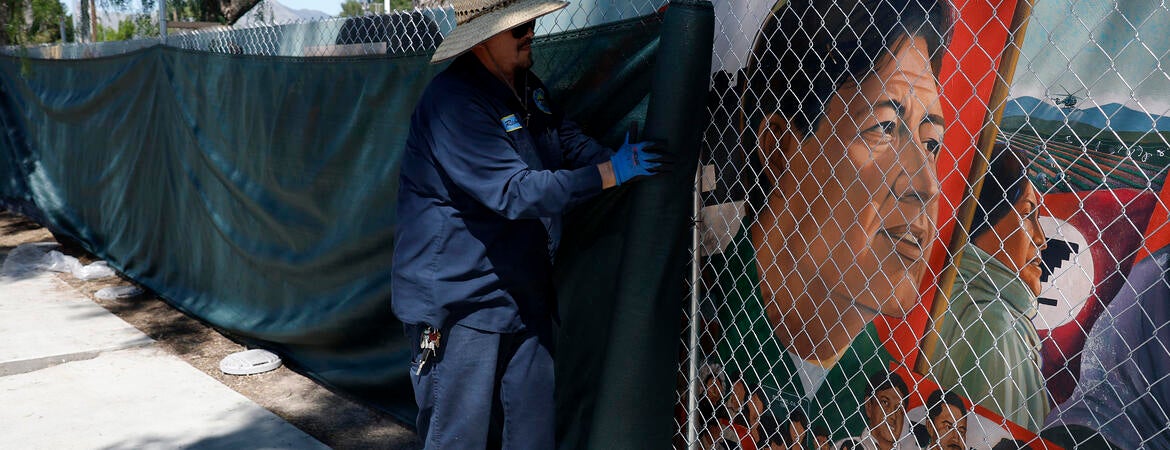
(Header image: Getty Images/Justin Sullivan )