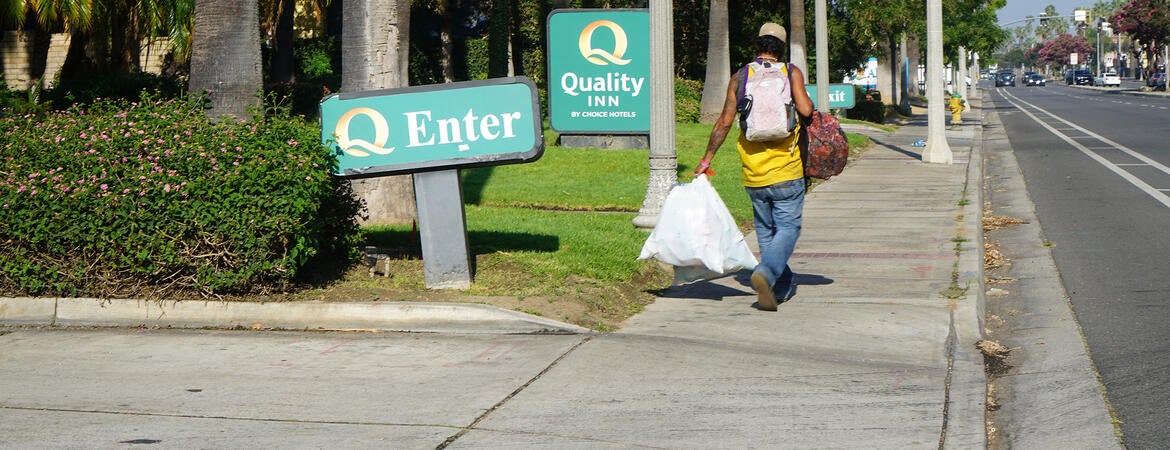

The Riverside City Council’s decision earlier this year to reject more than $20 million in state funding for a proposed homeless housing project has become one of the city’s most contentious public policy debates in years.
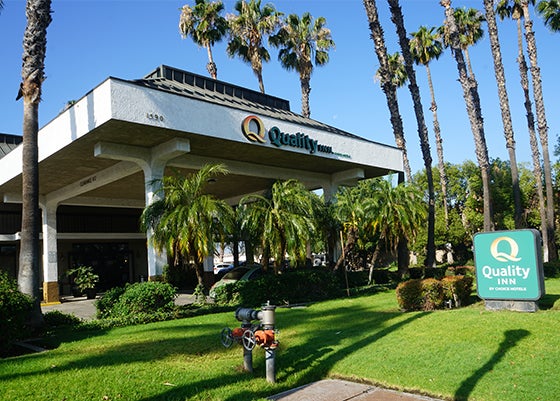
In a 4-3 vote in January, the council declined state Homekey+ funds that would have converted the Quality Inn on University Avenue near UC Riverside into 114 studio apartments for people experiencing homelessness. The proposed permanent supportive housing project would have included access to services such as mental health care, addiction counseling, case management, and more, according to a city staff report.
Supporters argued the project represented a rare and compassionate opportunity to rapidly create a significant amount of needed housing at a time of rising homelessness and escalating housing costs.
Opponents said the proposal was advanced without sufficient community input and relied too heavily on California’s “Housing First” philosophy because residents would not have been required to participate in sobriety, addiction treatment, or other behavioral health programs as a condition of housing.
The controversy has since intensified. The American Civil Liberties Union and other advocacy groups filed state complaints alleging the city’s rejection of the project may have violated anti-discrimination and fair housing laws, prompting an investigation by California’s Civil Rights Department.
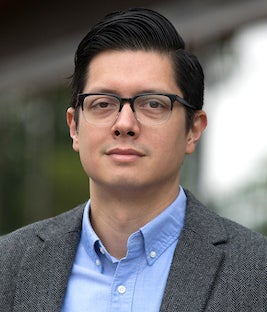
To better understand the policy and political issues behind the dispute, we asked UCR Assistant Professor Stan Oklobdzija in the School of Public Policy to share his expertise in state and local politics and housing policy.
Question: What does the Riverside Quality Inn controversy reveal about the larger political and public policy challenges surrounding homelessness and affordable housing in California cities?
Oklobdzija: Homelessness is first and foremost a housing problem. California is home to about 50% of America’s unsheltered homeless population because California stopped building new housing in its coastal metros around the 1980s. As a result, California metros like Los Angeles and the San Francisco Bay Area consistently rank as some of America’s least affordable when looking at average incomes compared to average home costs.
Research demonstrates that homelessness rates spike when average housing costs grow beyond about 30% of average incomes. Homelessness rates do not correlate with factors such as drug use, weather, or other factors commonly brought up by both elected officials and laymen. While California spends quite a bit on social services and provisional housing for the homeless (the Newsom administration spent about $24 billion between 2018 and 2024), high housing costs mean the state is forcing people into homelessness faster than it can transition them out via social services.
The chief culprits behind California’s housing crisis are local governments. Despite a series of bills aimed at wrestling authority away from them that were passed in recent years, most land use policy is made by California cities. Until very recently, cities faced little to no penalty for failing to build their fair share of housing; thus, they didn’t. Local elected officials, either because they agreed with them or because they were afraid of crossing them, deferred to local activists who ran pressure campaigns against new housing based on objections about parking, crime, or nebulously defined “neighborhood character.” In the aggregate, this failure to build created regional shortages, which in turn drove up housing prices.
It’s incorrect to bin housing into an “affordable” vs. “not affordable” dichotomy. While certain types of housing have costs fixed to some portion of local median income and are restricted to households earning below a certain amount, this housing generally must be built with a massive government subsidy, and makes up an incredibly small percentage of California’s total housing. When people speak about “affordable housing,” they’re generally referring to housing that is affordable–either because it is old or less desirable for some other reason. There is no way to build a new building that is “affordable”—construction, land, and financing costs are simply too high.
Riverside City Council's rejection of a $20 million state grant is emblematic of the failures of letting local governments handle land use issues. Though housing and homelessness are regional issues, local elected officials answer to local voters—and a tiny subset of local voters, given how low turnout is in municipal elections. The voters who do show up at the polls are more likely to be homeowners, and those who show up to local government meetings are whiter, older, and richer than the average person, even within their city. These voters disproportionately hold anti-housing views and are especially hostile towards facilities like homeless shelters. Though facilities like the proposed Quality Inn shelter are desperately needed in places like Riverside County—where there are about 4,200 homeless people as of the latest count and about half that number are unsheltered—local elected officials find it more expedient to simply kick the can down the road rather than angering local “Not in My Back Yard,” or NIMBY, activists.
Q: Supporters said rejecting the $20 million grant represented a lost opportunity to quickly create more than 100 housing units for homeless residents. In your view, how significant was this decision in practical terms for Riverside’s homelessness crisis?
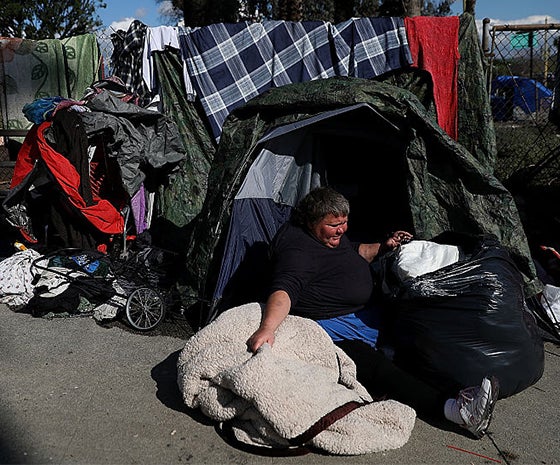
Oklobdzija: Again, there are about 4,200 total homeless people in Riverside County, 2,400 of whom are sleeping in cars, tents, or other improvised shelters. To put these numbers in perspective, there are about 4,600 homeless people in the entire state of Alabama, 2,600 of whom are unsheltered. Riverside County has about 2.5 million people total, and Alabama has about 5.1 million people. The scale of California’s homelessness crisis puts us in a different league than the vast majority of other American states.
Riverside also permits far less new housing than comparable-sized cities in other states. Post 2009, it permitted about half as many units per year as Corpus Christi, Texas. Orlando, Florida, and Durham, North Carolina, produced about five to six times more housing per year, respectively, than Riverside.
It’s quite a juxtaposition of values for Riverside elected officials to permit so little housing—a key driver of housing price increases, which in turn drives homelessness—and then turn around and also deny homeless supportive housing. While it may make sense for local elected officials who have no vision beyond their reelection to mollify local NIMBYs, it illustrates the folly of California leaving such consequential decisions to people with such parochial and short-sighted interests. One hundred units denied means an untold multiple of human beings condemned to life on the street. In nearby Los Angeles County, six homeless people die on the streets every single day. This is the fate Riverside city councilmembers have chosen for the people they’re supposed to represent.
Q: Riverside officials who opposed the project argued that the “Housing First” approach lacks accountability because residents would not be required to participate in treatment or sobriety programs, although those services would be available to them. What is Housing First, and what is known about its impact on participation in mental health, addiction treatment, and similar programs?
Oklobdzija: The evidence is clear that Housing First approaches—where housing is provided unconditionally to those in need—reduce both homelessness rates and improve quality of life outcomes for homeless individuals. Getting people housed also increases the likelihood that they will both start and successfully complete both mental health treatments and addiction recovery. Furthermore, Housing First approaches reduce costs for jurisdictions that implement them because the homeless no longer consume expensive emergency services.
Q: From a public policy perspective, what is known about the effectiveness of compulsory treatment or sobriety requirements in housing programs?
Oklobdzija: Again, Housing First approaches, which solve the homelessness problem directly, are shown to be more effective than conditioning housing on participation in various types of programs.
Q: Several council members said nearby residents and businesses were not adequately consulted before the proposal advanced. How important is community engagement in projects like this, and what lessons should cities learn from Riverside’s experience?
Oklobdzija: One of the reasons California is in such a dire housing crisis is that local residents feel they should be given a veto over development on property that they do not own. All city council actions are properly noticed to the entire community three days in advance according to the Brown Act. The city draws up a zoning map and land use law in public meetings. The foundational principle of democracy is one-person, one-vote, no matter where in the city they live. Living next to a legally permissible structure does not give someone the right to demand an extra vote. Homelessness is an issue that affects all people in Riverside and throughout the region. If nearby residents and business owners are displeased with their representation, they are free to vote against their incumbent councilmember or the mayor at the next election. This is how deliberation in a democracy works.
As a larger point, the notion that a local government must open the floor to unrepresentative samples of the community to scream at elected officials before every land use decision is absurd. Overwhelming empirical evidence shows that the people who attend local government hearings are not representative of the community at large and often hold wildly divergent preferences. Local elected officials who are interested in learning what the community thinks should turn to polling or forms of deliberative democracy to ensure they are not learning from a biased sample and are actually weighing the preferences of everyone in the community–not just the loudest voices with nothing to do in the middle of the day on a Tuesday.
Header image: A man with two knapsacks and a plastic bag full of salvaged recyclable plastic bottles walks past the Quality Inn, the site of a proposed and then rejected homeless housing project, on University Avenue in Riverside, Calif. (UCR/David Danelski)