
While America’s 250th anniversary evokes iconic images of Thomas Jefferson drafting the Declaration of Independence and George Washington crossing the Delaware, the Revolutionary era extended far beyond the Atlantic seaboard.
To bring that coast-to-coast history to light and uncover the stories of California’s earliest residents, UC Riverside history professor Steven Hackel has been awarded a $350,000 grant from the National Endowment for the Humanities (NEH) to expand the Early California Population Project (ECPP). It's the largest NEH grant to a single researcher at UCR in at least a decade.
The award was announced July 22 as part of a $41.4 million initiative funding 81 humanities projects nationwide. UCR was the sole recipient among the UC campuses and one of only two institutions selected in California.
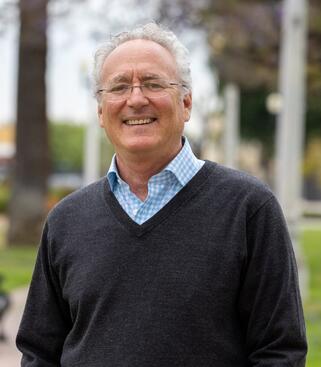
Since the early 1990s, Hackel has been documenting the lives of California’s Indigenous and colonial populations. Launched in the early 2000s with NEH funding, the ECPP compiles records from California’s 21 missions — including baptisms, marriages, and burials — and preserves the life histories of more than 110,000 Californians between 1769 and 1850.
Hackel’s new NEH grant was awarded under the organization’s “Rediscovering Our Revolutionary Tradition” category, which aims to improve access to primary source materials related to America’s founding era, early government, and geographic expansion.
“This NEH funding opportunity was explicitly tied to America’s 250th anniversary, with its strong emphasis on the British colonies, so we defied the odds as a California selection,” Hackel said. “This project will draw out of the shadows of American history the thousands of Spanish soldiers, settlers, missionaries, and Native Americans who lived in California during America’s founding era, many of whom contributed, if only indirectly, to the Patriots’ war efforts.”
The grant will enable Hackel to lead a comprehensive expansion and redesign of the ECPP database, dubbed ECPP 2.0. The expansion will incorporate roughly 20,000 records of immigrants, creating a fuller picture of the intertwined lives of Native peoples and settlers, as well as the role they played in America’s founding.
The technical redesign will improve the functionality of the resource, migrating the legacy database to the GEDCOM format now widely used to exchange genealogical data. Researchers will also build a spatial map plotting ancestral Native communities and tracking the movements of Indigenous people between their villages and the California missions.
“Native people lived across the entire region between San Diego and San Francisco, and the mission records captured their life events in remarkable detail,” Hackel said. “By mapping hundreds of these ancestral villages, we can visualize how communities moved, interacted, and survived, providing an invaluable resource for both historians and descendants tracing their heritage.”
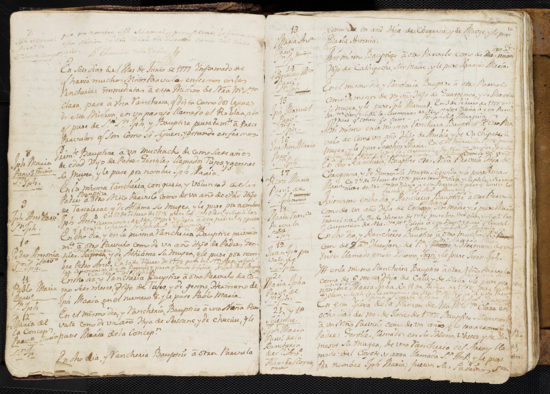
The ECPP was initially developed at the Huntington Library where Hackel spent years as the project’s general editor overseeing a staff of scholars who deciphered and cataloged fragile mission records. In 2007, Hackel joined the UCR faculty, and, in 2022, the database permanently transitioned to the university with support from the Huntington and Daryle Williams, dean of UCR’s College of Humanities, Arts, and Social Sciences (CHASS). Since the transfer, the Huntington has remained an important partner by providing reference assistance to users, and this new version of the database will almost certainly depend upon access to documents in the Huntington’s collection.
"We should all be immensely proud of this prestigious, competitive national award,” Williams said. “When Steven brought this project to UCR, we knew its potential to draw upon the digital humanities to see early America anew. ECPP 2.0 exemplifies our dedication to the study of the many peoples and places who make United States history, and we await many new discoveries to come from the project.”
Securing the grant was a collaborative effort, Hackel said. Raymond Holguin, chief technology officer in CHASS, and his technical team laid the groundwork for the GEDCOM transition, while Clifford Trafzer, distinguished professor of history, provided funds from the Costo Endowment to support graduate student researchers over the past two summers.
Hackel said the grant recognizes the importance of making California’s foundational history accessible to all.
“This grant reminds us that California’s colonial history is part of the early American narrative, not a sideshow that took place on the West Coast when nobody was looking or paying attention,” he said. “On a personal note, it is a recognition that we’re building something of enduring value to Californians tracing their family history and their personal identities. Everybody wants to know who they came from, and this helps a lot of people uncover their own personal story.”
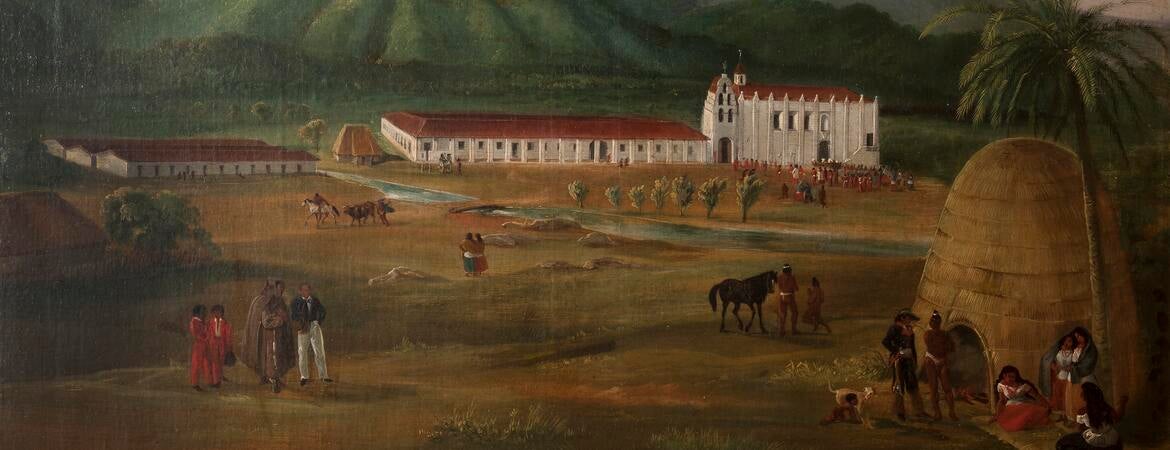
Header image: Mission San Gabriel Oil Painting by Ferdinand Deppe. Oil on canvas, 1832. (Credit: Santa Bárbara Mission Archive-Library)