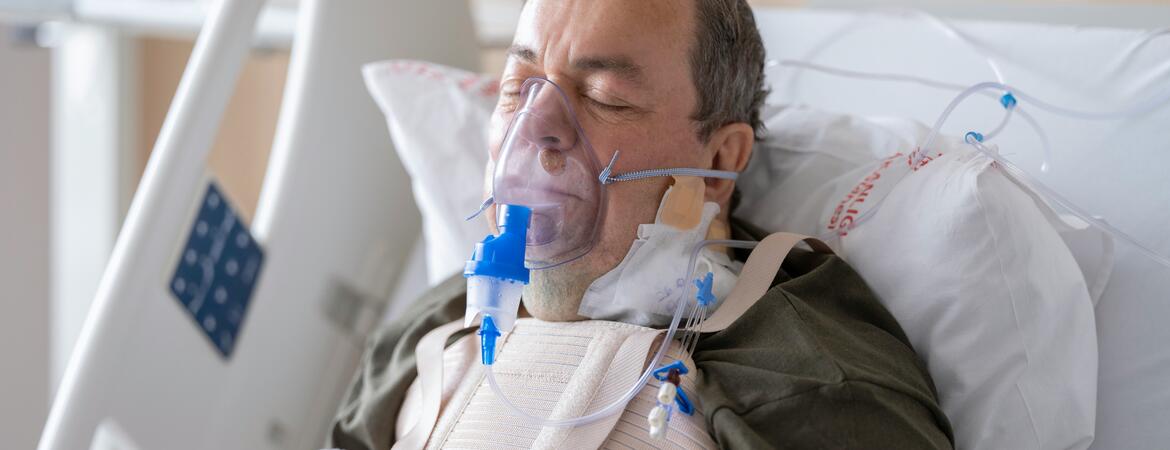

The sensation of shortness of breath can be particularly severe for people with conditions such as chronic obstructive pulmonary disease (COPD) and patients receiving mechanical ventilation in intensive care.
But such respiratory discomfort can easily go unnoticed. Even when patients on ventilators can communicate, there can be a disconnect between their experience and how a physician interprets it. Significant discomfort, therefore, may not be adequately addressed, often contributing to heightened anxiety and fear in patients, long-term psychological trauma, and poorer clinical outcomes.
Erica Heinrich, an assistant professor of biomedical sciences in the UC Riverside School of Medicine, has received a $3.5 million grant from the National Institutes of Health’s National Heart, Lung, and Blood Institute to further study dyspnea — the clinical term for shortness of breath. The goals of the five-year project are to better understand the physiological signals associated with dyspnea, develop ways to identify when patients are suffering, and ultimately improve their care.
“The research could ultimately provide physicians with a new tool to recognize and monitor respiratory distress in patients who may be unable to communicate it themselves and help guide interventions to improve their comfort and outcomes,” Heinrich said.
The research will build on Heinrich’s previous work studying shortness of breath with the goal of connecting basic physiological research to clinical applications. It has two primary aims.
The first will use laboratory experiments to induce shortness of breath in different populations and collect a range of biomarker data. Heinrich and her collaborators will use that information to develop a machine-learning algorithm capable of predicting respiratory comfort. Such a model, Heinrich said, can identify significant dyspnea more accurately than physicians’ observational estimates.
A challenge for the team is determining whether the model works across different patient populations. The researchers have shown its effectiveness in people with healthy lungs, but patients with COPD have changes in lung mechanics and adaptations in the neural control of breathing.
The second aim will extend the experiments to COPD patients. The researchers will monitor multiple biomarkers while inducing shortness of breath through different mechanisms, including exercise and airflow resistance. The study will include an intensive care unit cohort at UC San Diego’s Jacobs Medical Center.
“The clinical population is particularly important because ICU patients can have severe lung pathology, while also receiving medications that can alter how the brain processes signals and how the patient perceives dyspnea,” Heinrich said. “Patients may be receiving pain medications, sedation, or neuromuscular blockade that leaves them unable to move or communicate. However, paralytic drugs do not prevent dyspnea but mask a patient’s distress. Determining whether respiratory discomfort can still be accurately predicted under those circumstances is critical because these are among the patients who could ultimately benefit most from the technology.”
Heinrich is particularly interested in patients who are receiving mechanical ventilation. She said there is strong evidence that ventilated patients can experience severe shortness of breath, which can increase anxiety and affect clinical outcomes, including when a patient can successfully be weaned from a ventilator.
The research could also benefit people living with COPD outside the hospital.
“For these patients, quality of life is closely connected to the severity and frequency of their dyspnea,” Heinrich said. “A way to continuously monitor and quantify that experience could give physicians additional information to guide treatment. It could also give patients a stronger voice by providing objective data about the severity of the distress they experience.”
The project also reflects the need for federal investment in high-risk, high-reward research that may not otherwise attract sufficient financial support.
“Some conditions have significant effects on patients but affect relatively small populations,” Heinrich said. “Federal agencies and other large-scale research funders can help ensure that such patients are not overlooked and the conditions affecting them receive scientific attention.”
The project brings together UCR researchers like Shujie Ma, a professor of statistics with expertise in machine learning, analyzing large clinical datasets, and working with real-time biomarker data. Mona Eskandari, an assistant professor of mechanical engineering with expertise in lung-tissue mechanics, will design experiments to determine whether the algorithm performs better or worse than physicians’ predictions of respiratory comfort.
Ultimately, Heinrich sees the research as the foundation for a tool that could give physicians information they lack.
“We hope that in the future, patient monitors can provide a readout indicating whether a patient receiving mechanical ventilation is experiencing significant dyspnea, allowing physicians to make more informed decisions about treatments and interventions,” she said.
Heinrich cautioned the technology is not intended to replace a physician’s clinical judgment. Rather, she sees the predictive algorithm as a tool for physicians and a potential voice for patients who cannot communicate.
“Our ultimate goal is to provide clinicians with information leading to meaningful interventions, relieving patient distress and improving outcomes,” Heinrich said.
Header photo by engin akyurt on Unsplash.