

With a global ocean of liquid water below a thick crust of ice, Saturn’s moon Enceladus is one of the most promising places to search for life beyond Earth. A new study suggests the moon itself may aid in that search by making some ocean compounds easier for future spacecraft to detect.
At the moon’s south pole, jets of water vapor and tiny ice particles erupt from Enceladus’s ocean and extend hundreds of miles into space to feed Saturn’s E ring. NASA’s Cassini spacecraft, which arrived at Saturn in 2004, repeatedly flew through this plume, allowing it to sample ocean-derived material without landing or drilling through miles of ice. Cassini detected salts and organic compounds, as well as evidence of water-rock interactions occurring on the moon’s rocky seafloor.
Published Sept. 25 in Science Advances, the study examined how different salts separate and become concentrated in different grains as ocean spray freezes and travels through cracks in the ice. Crucially, a similar process may concentrate organic molecules, and potentially molecular biosignatures, into individual grains, making them much easier for future spacecraft to detect.
The study examined nearly 1,000 individual salt-rich ice grains recorded by Cassini’s Cosmic Dust Analyzer. Some grains were rich in sodium chloride. Others were dominated by carbonates, phosphates, hydroxides, or potassium-bearing salts.
“We show that each grain is not necessarily a tiny scoop of the ocean,” said Fabian Klenner, a UC Riverside assistant professor of planetary sciences and co-author on the study. “It is more of a fragment of a much larger ocean droplet in which freezing separated the salts before that droplet broke apart.”
To reconstruct that process, the researchers combined Cassini data with laboratory experiments, thermodynamic calculations, and models of droplet cooling. In the experiments, they froze droplets of alkaline salt water formulated to resemble the Enceladus ocean. Larger droplets that cooled relatively slowly developed distinct salt-rich regions, while the smallest and most rapidly frozen droplets remained more uniform.
“When these droplets freeze relatively slowly, different salts can separate into distinct regions within a single grain,” Klenner said. “For example, sodium chloride could concentrate in one region and potassium chloride in another. As the grain is accelerated through the vents, collisions with the icy walls can break it into smaller fragments with different compositions. This is the mechanism we propose.”
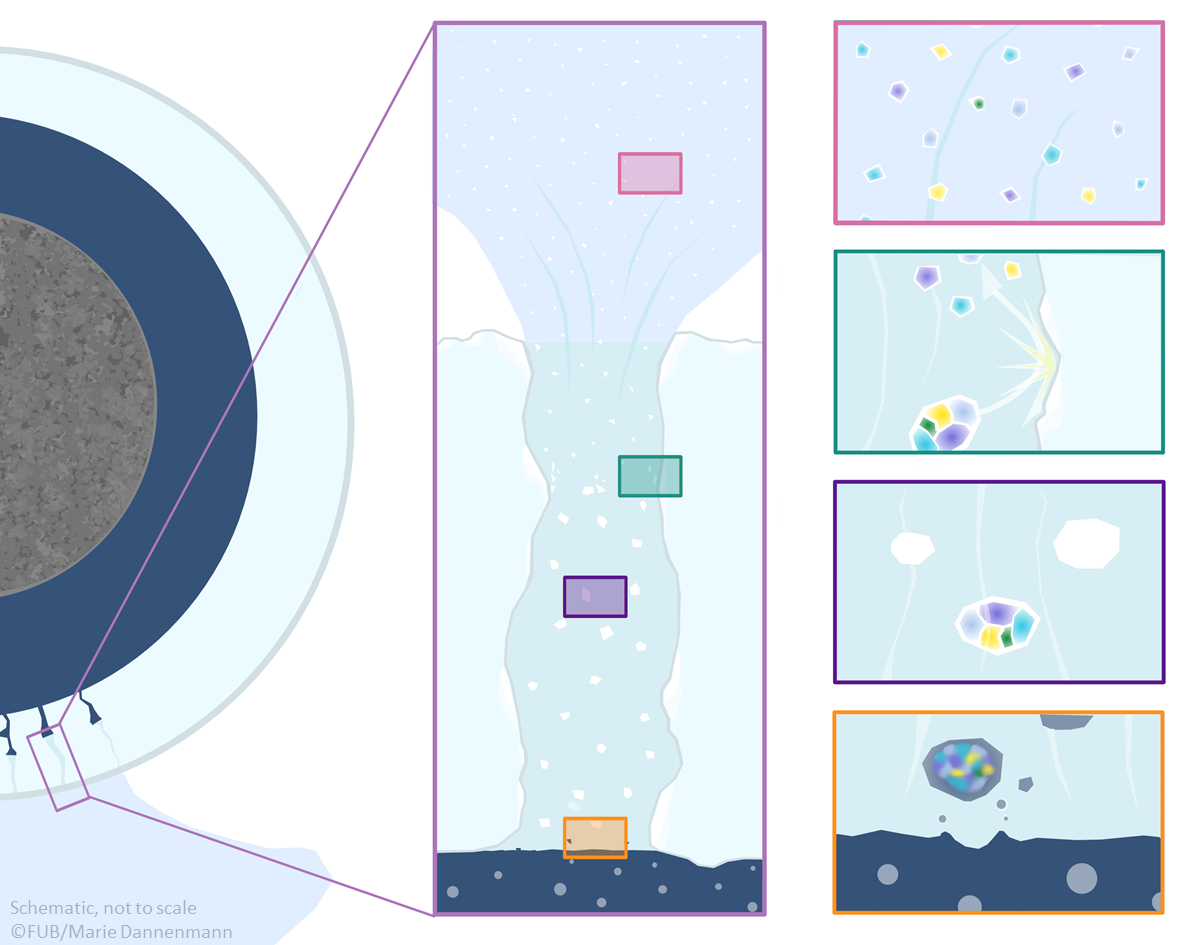
The research team’s model begins when bursting bubbles at the ocean surface produce spray droplets. Water vapor carries the droplets upward through the vents, where they freeze slowly enough for different salts to separate. Closer to the surface, narrower passages accelerate the vapor and frozen droplets to a few hundred miles per hour, and collisions with the icy walls break them into micrometer-scale fragments.
“Enceladus actually does a lot of the work for us in preparing samples for analysis that usually take a lot of effort in chemical labs on Earth,” said Frank Postberg, a professor of planetary sciences at Freie Universität Berlin who led the study. “The oceanic constituents are separated from each other and simultaneously concentrated into individual ice particles.”
The finding also changes how scientists should interpret plume samples. A single grain may not represent the ocean’s average composition. Combining many particles into one measurement could erase the natural separation and conceal rare compounds, while analyzing grains individually preserves that information.
“Analyzing a large number of individual grains increases our chances of finding interesting compositions and gives us a better picture of the ocean as a whole,” Klenner said. “The most useful information is in the differences from grain to grain. Future missions should analyze as many individual grains as possible.”
Klenner said related physical processes may help explain why some organic compounds occur at elevated concentrations in only a small fraction of Enceladus ice grains.
“This tells us something important about the search for life on Enceladus,” he said. “Molecular signatures of life, if present, may be concentrated in only a few grains. A future spacecraft has to find exactly those grains.”
Searching for habitable environments and signs of life beyond Earth is a focus of Klenner’s research at UCR. His laboratory studies how organic molecules and possible biosignatures would appear in individual ice grains, and how spacecraft mass spectrometers could distinguish biological from nonbiological chemistry.
The research included collaborators in Germany, Japan, China, the United Kingdom, and the United States.
Klenner was funded by NASA and the European Research Council.
The title of the paper is “Cassini CDA observes compositional segregation of Enceladus’ ice grains from slow freezing and fragmentation of oceanic spray.”
Header image credit: NASA / Handout.