
In a new book, sociologist Brandon Andrew Robinson calls for abolishing sexual identities.
Robinson, an associate professor of gender and sexuality studies at UC Riverside, knows it’s a provocative thesis. But they argue that discarding these labels is a critical step toward giving people the freedom to relate to one another on a deeper, more respectful, more meaningful, and more pleasurable level. Sexual identity, Robinson asserts, functions as a kind of prison, confining human desire and reinforcing a false notion of gender based on fixed, biological categories.
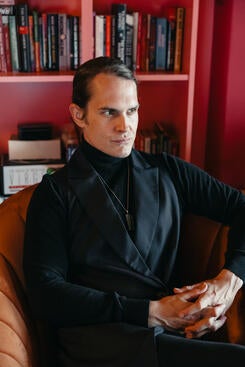
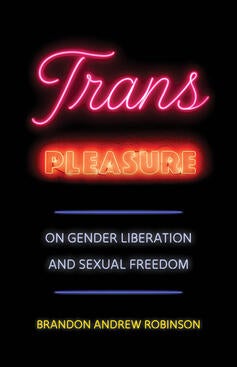
“Identities limit us,” Robinson writes in “Trans Pleasure: On Gender Liberation and Sexual Freedom.” “And the fact that we keep creating new identities — such as gynosexual, finsexual, sapiosexual, asexual, or pansexual — shows how these categories fail to capture the full complexities of gender, sexuality, and desire.”
The book, published Feb. 24 by the University of California Press, draws on hundreds of Reddit conversations about transgender women and their sexuality and dating experiences, as well as from 48 qualitative interviews conducted over Zoom with trans women and trans femmes — trans people who identify with a feminine gender expression.
Robinson spoke with UCR News about the book’s genesis, the inspiration they took from the poet and essayist Adrienne Rich, and the importance of trans for trans (t4t) gathering places and online communities that offer supportive environments for transgender people.
What inspired you to write a book focusing on the dating and sex lives of transgender women and femmes?
Robinson: My last book, “Coming Out to the Streets,” was about LGBTQ youth homelessness. I spent 18 months sleeping in shelters, hanging out with young people. It’s a depressing subject. I decided I wanted to tackle a more uplifting project for my next book. The vast majority of current research on trans women focuses on discrimination, violence, and health risks, but their lives are much more than statistics about murder rates and workplace discrimination.
I became curious about what their everyday dating and sex lives look like. We don’t know much about those topics. I wanted to explore how trans women and femmes feel about going on dates, navigating dating apps, hooking up. I set out to examine trans people as desiring and desirable subjects to provide a more complex and in some sense joyful understanding of their lives, which aren’t only defined by trauma.
You started the book project during the pandemic. How did that shape your research process, and how did you find people to interview?
Robinson: As a sociologist, I was trained to do in-person interviews, but the pandemic made that impossible. So, I started by diving down Reddit rabbit holes. I wanted to see how people were talking about their desires for trans people, and how trans people were talking about their own desires around dating. Eventually, sociologists pivoted to using Zoom for interviews, which, for my purposes, was great; it gave me a much broader reach. If I had proceeded with traditional, in-person interviews, I would have had the means to only interview people from Southern California.
I made a flyer, which went through UCR’s Institutional Review Board, offering trans women $100 for a one-hour interview. I posted the ad on Twitter and sent it to LGBTQ organizations. In less than 12 hours, I got over 100 responses. I think many trans women were enthusiastic about joining because they had never been asked about this part of their lives before.
In formulating the book’s arguments, you say you were influenced by the concept of compulsory heterosexuality that Adrienne Rich introduced in her famous essay from 1980. Could you explain this idea and how it intersects with your thesis?
Robinson: It basically means that heterosexuality is a system — a political institution — that oppresses women, limits their choices, and forces them into dependency on men, while erasing the existence of lesbians or demeaning them as deviants. Thus, women are compelled into thinking heterosexuality is the only proper way to be in society.
In my book, I give the concept a twist. I wanted to see how it was shaping trans women’s lives. In Rich’s era, there was “lesbian separatism” — a strategy in which lesbians separated from men to fight the patriarchy.
For the trans women in my study, dating other trans people was often a response to compulsory heterosexuality. They felt that cisgender people [individuals whose gender identity matches their sex assigned at birth] often only desired them based on stereotypes. They also felt exhausted by the labor of having to explain their bodies and trans identities to their cis dates. There’s nothing erotic or fun about doing that. We go on dates to discuss our interests and our hobbies or, you know, what TV shows we like — not our bodies, right?
Most participants in my study turned to other trans people for dates, hookups, and relationships because other trans people just “got it.”
You discuss t4t — or trans-for-trans — relationships. Could you talk about what role t4t dating, dating sites, and communities play in the lives of trans women?
Robinson: It’s complex. I firmly support t4t because it allows trans women to avoid the fetishization and transphobia they often experience with cis people. It’s a respite where they can find recognition and be loved and cared for without doing constant labor. It’s beautiful to hear them talk about finally being seen.
However, I’m also wary because trans people deserve to be loved and recognized by cis people, too. The fact that they turn to t4t points to structural problems — societal transphobia and a lack of education. Of course, t4t isn’t a viable option for everyone, such as someone living in rural Appalachia, where there may not be a large trans community to date.
You coin the term “sexual cissexism” in your book. What does it mean and how does it relate to understanding desire?
Robinson: I built on previous research regarding sexual racism — the idea that desires are often bound to racial stereotypes. Sexual cissexism describes how we view sexuality through a cisgender lens, with cis bodies being the norm for what is considered proper or desirable. This framework often leads to trans women being either completely rejected or only desired through harmful, hyper-feminine, or pornographic stereotypes.
If our desires are broadly influenced by these kinds of sexual stereotypes, how do we move toward healthier ways of relating to one another?
Robinson: I think one way is to center what I might call the four C’s: communication, comfort, care, and consent.
For example, many cis men first recognize their desire for trans women through pornography, which is often an unhealthy, stereotypical lens. By building actual connection and respect, people can break down those stereotypes and develop a healthier understanding of their own desires and of other people’s desires and bodies as well.
You argue for abolishing sexual identities. Why get rid of labels like gay or lesbian when many people have found them useful for understanding themselves and finding a sense of belonging?
Robinson: It’s a several-fold argument. First, I want people to question why we privilege gender and genitals above all other attributes — like height or race — when we conceptualize our sexual identity.
Secondly, these categories often rely on gender essentialism. If being “gay” means being a man attracted to men, it assumes “man” is a stable, inherent category, when history shows the definition of manhood is constantly changing. Gender essentialism also harms trans people, who often complicate those binary boundaries.
But if you get rid of these labels, don’t you risk dismantling the communities that have formed under their rubrics and, by extension, the political protections that marginalized people have fought for decades to gain?
Robinson: I think the risk is worth it. While those communities are important, moving beyond those labels allows us to see people more accurately. It leads to a more complex — and more biologically accurate — understanding of ourselves as human beings. It allows us to explore our desires beyond labels that often confine and constrain us. And it allows us to explore our desires beyond shame that often comes with many labels as well.
This interview has been edited and condensed.
(Header photo: Getty Images / Johnny Greig)