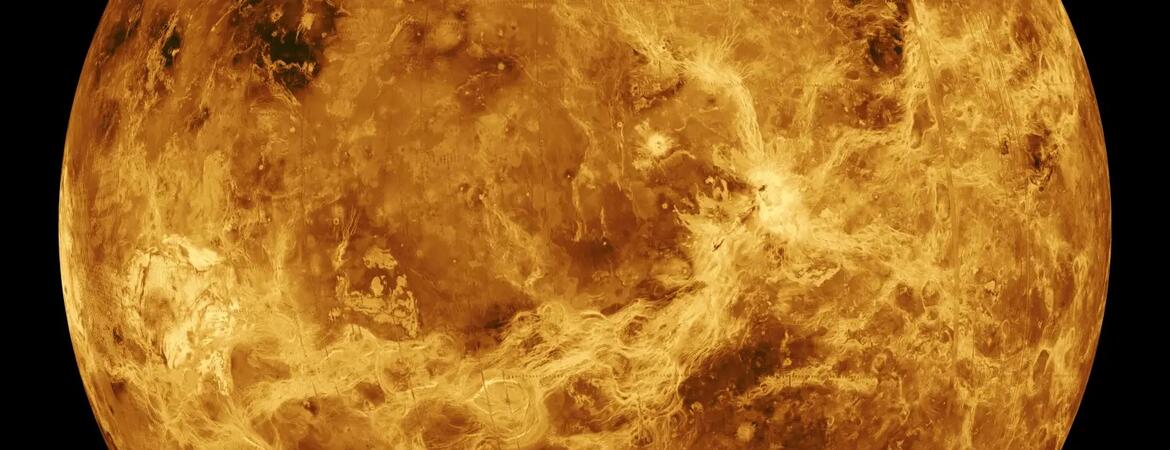

Scientists have long speculated why Venus, with a similar size, mass, and structure to Earth, doesn’t have a moon. New UC Riverside research shows it’s because our hungry twin likely swallowed it.
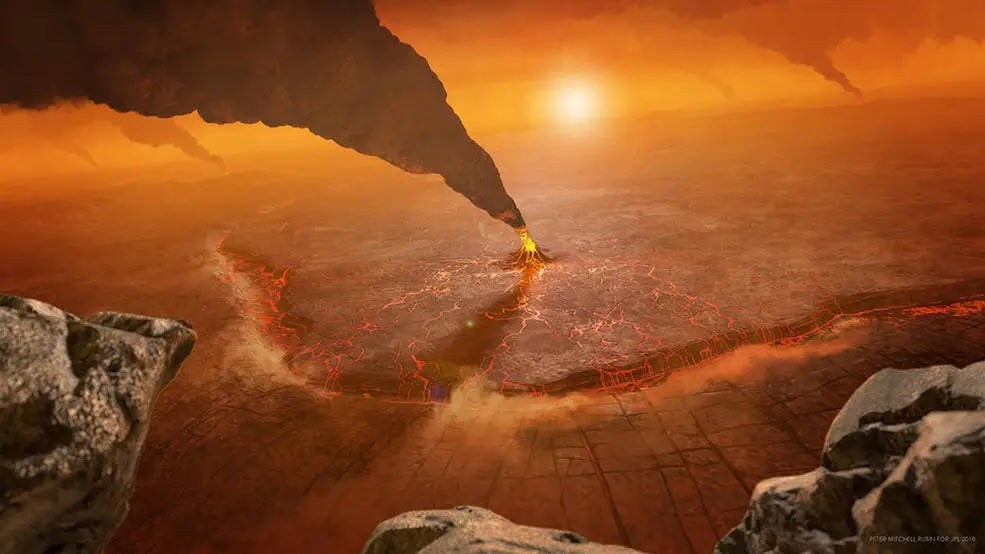
(NASA/JPL-Caltech/Peter Rubin)
In the past, scientists have theorized that Venus possibly had a moon at one time that got hit with something massive, obliterating it. Other theories centered around the idea that Venus never underwent a collision that formed a moon in the first place.
The new research, published in The Astrophysical Journal, shows that neither theory fits.
“My study shows Venus didn’t require a catastrophe to arrive at what we can see today,” said UCR astrophysicist and lead author Stephen Kane. “It turns out the gravity of the planet itself combined with the rate at which it spins naturally caused the moon to collapse on top of it.”
Scientists can precisely measure the distance between Earth and the moon because NASA’s Apollo 11 landing left mirrors there. “We know that the moon is slowly moving away from the planet, at a rate of around four centimeters per year,” Kane said. This distancing, Kane said, is happening because Earth spins at a relatively fast 24 hours per rotation. The energy from this spinning gets transferred to the moon, causing it to distance itself.
Venus has the exact opposite situation. It takes that planet 243 Earth days to complete a single rotation. So, rather than gradually moving away, the slow spin and the planet’s gravity would cause a moon to spiral inward toward a collision.
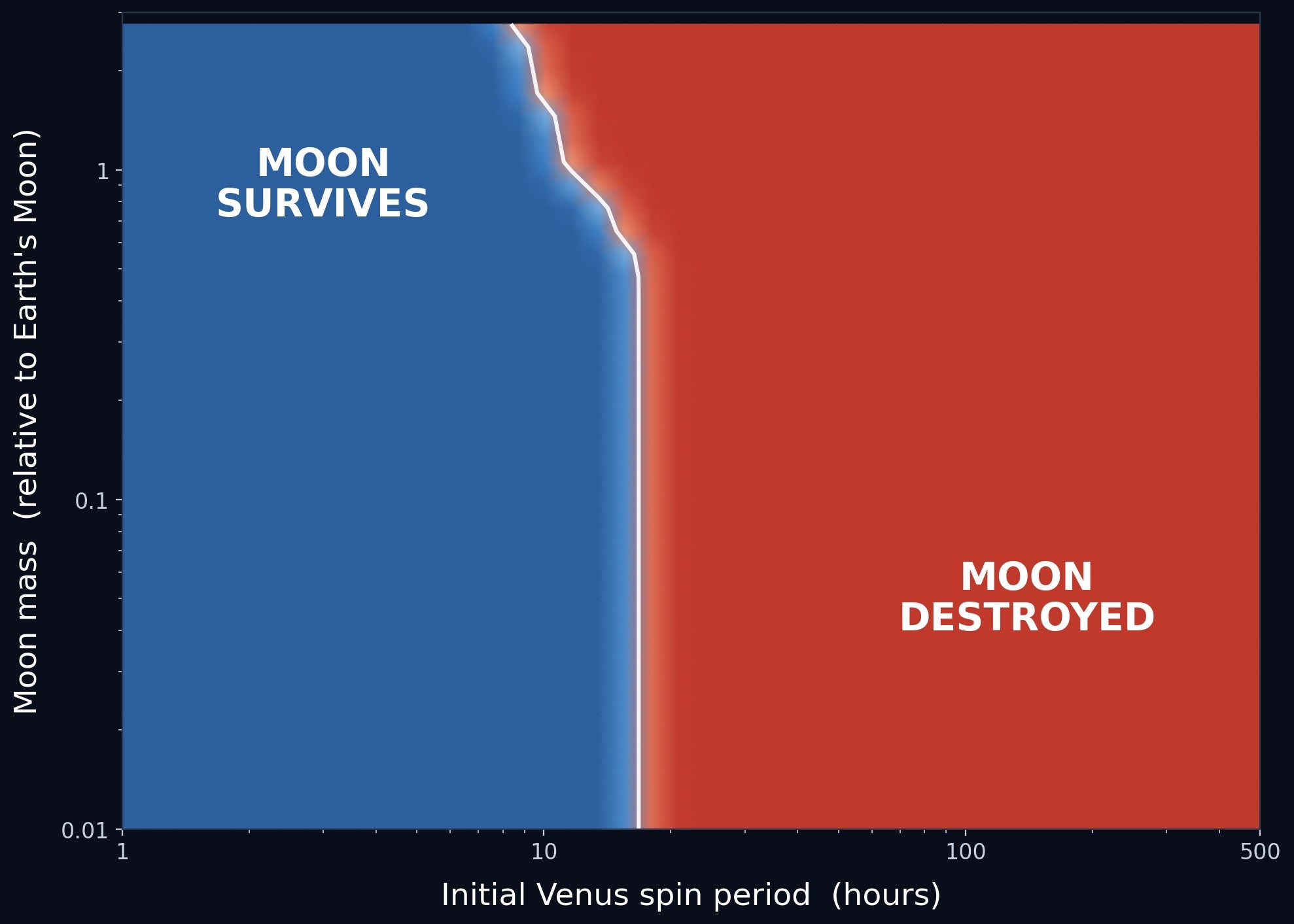
To test this idea, Kane wrote computer models based on the physics of how planetary bodies interact through gravity. He first reproduced the evolution of Earth and its moon to make sure the model accurately represented a known system.
Then he varied Venus’ rotation rate and the size of its hypothetical moons, testing moons with masses ranging from half to ten times the mass of Earth’s moon. In most simulations, the result was the same: the moon crashed into Venus. And the more massive the moon, the faster it crashed.
“When I made this discovery, I was shocked,” Kane said. “I thought surely the broad range of scenarios I was exploring would lead to a variety of results. But it all went pretty much in the same direction.”
The finding does not prove that Venus once had a moon. Kane believes it may have, but whether one ever formed remains an open question. The study does show that if Venus had a moon, it could not have continued existing indefinitely.
Finding physical evidence of such a collision would be difficult. Roughly 80% of Venus’ surface is similar in age, evidence of a major resurfacing event about a billion years ago that erased much of the planet’s earlier geological history.
Evidence could instead lie beneath the surface. Scientists believe Earth’s moon formed after a massive collision early in the planet’s history, and seismic studies have revealed unusual structures deep inside Earth that may be remnants of that event. Similar measurements on Venus could offer clues about whether it once absorbed a moon.
Such a collision could also help scientists understand another longstanding mystery about Venus: whether Earth’s nearest planetary neighbor was ever capable of hosting life.
A moon crashing into Venus would have transferred enormous energy and angular momentum to the planet, potentially changing its rotation, geology, and climate. If Venus once had oceans or other conditions favorable to life, such an impact could have altered the course of the planet’s evolution.
The implications extend beyond Venus. Scientists searching for potentially habitable worlds around other stars often look for planets resembling Earth and consider the presence of a moon one factor that could influence habitability.
Earth’s moon drives tides, may have helped keep the planet geologically active, and has profoundly influenced Earth’s evolution. Scientists do not know, however, whether a large moon is necessary for life.
“My feeling is there are benefits to having a moon, but it isn’t required for habitability,” Kane said. “The moon has definitely changed the way Earth has evolved through time, but we don’t fully know how important that role is.”
Kane’s findings suggest that even planets capable of forming moons may not be able to keep them. Slowly rotating worlds could send their moons spiraling toward their surfaces, dramatically changing the planets in the process.
“When people think about Earth twins around other stars, one question they ask is, ‘Does it have a moon?’” Kane said. “My study shows a disturbing scenario for many of those cases. If these planets don’t rotate fast enough, the moon will crash to the surface, and that would change the course of history for those planets.”
(Cover image of fiery Venus: NASA/Jet Propulsion Laboratory-Caltech)